
The Objects We Keep
Most of the objects I photograph were once ordinary things.
A camera was made to take pictures. A meter was made to measure electricity. A hand tool was made for a job. A Polaroid Land Camera was made to put a finished photograph in your hand within minutes.
None of these things began as art.
But time has a way of changing objects.
Eventually, usefulness fades.
Technology becomes obsolete. Tools are replaced. Cameras that once seemed advanced become curiosities. Instruments go quiet. Objects move from desks and workbenches into drawers, closets, attics, and boxes.
And yet we keep some of them.
That interests me.
Why does one old object get discarded while another follows us for decades?
I think the answer often has very little to do with the object itself.
We keep things because of what has attached itself to them.
A camera may remind us of a parent. A hand tool may carry the memory of someone who taught us how to use it. A book may contain a name written on the inside cover. A piece of obsolete technology may take us back to the years when that technology seemed new and full of possibility.
The object becomes a physical anchor for something that can no longer be touched.
This is one of the reasons still life continues to fascinate me.
The genre has existed for centuries, and at first glance its subjects can seem almost stubbornly ordinary: fruit, flowers, vessels, books, food, tools, household objects.
But ordinary objects are never entirely ordinary once we begin looking carefully.
Painters have long understood this. A flower can suggest beauty and impermanence. A half-peeled lemon can become sensual. A glass can demonstrate the virtuosity of a painter while also reminding us how fragile material things are.
The object is visible.
The meaning is not.
My own still-life work has gradually moved toward that invisible part.
I still care deeply about the physical presence of an object – its texture, surface, shape, and the way light moves across it. That is one of the pleasures of light painting. I can spend time with an object and build the illumination slowly, almost as if I were discovering it one piece at a time.
But increasingly, the surface is only the beginning.
What I want to know is why this object deserves to be photographed.
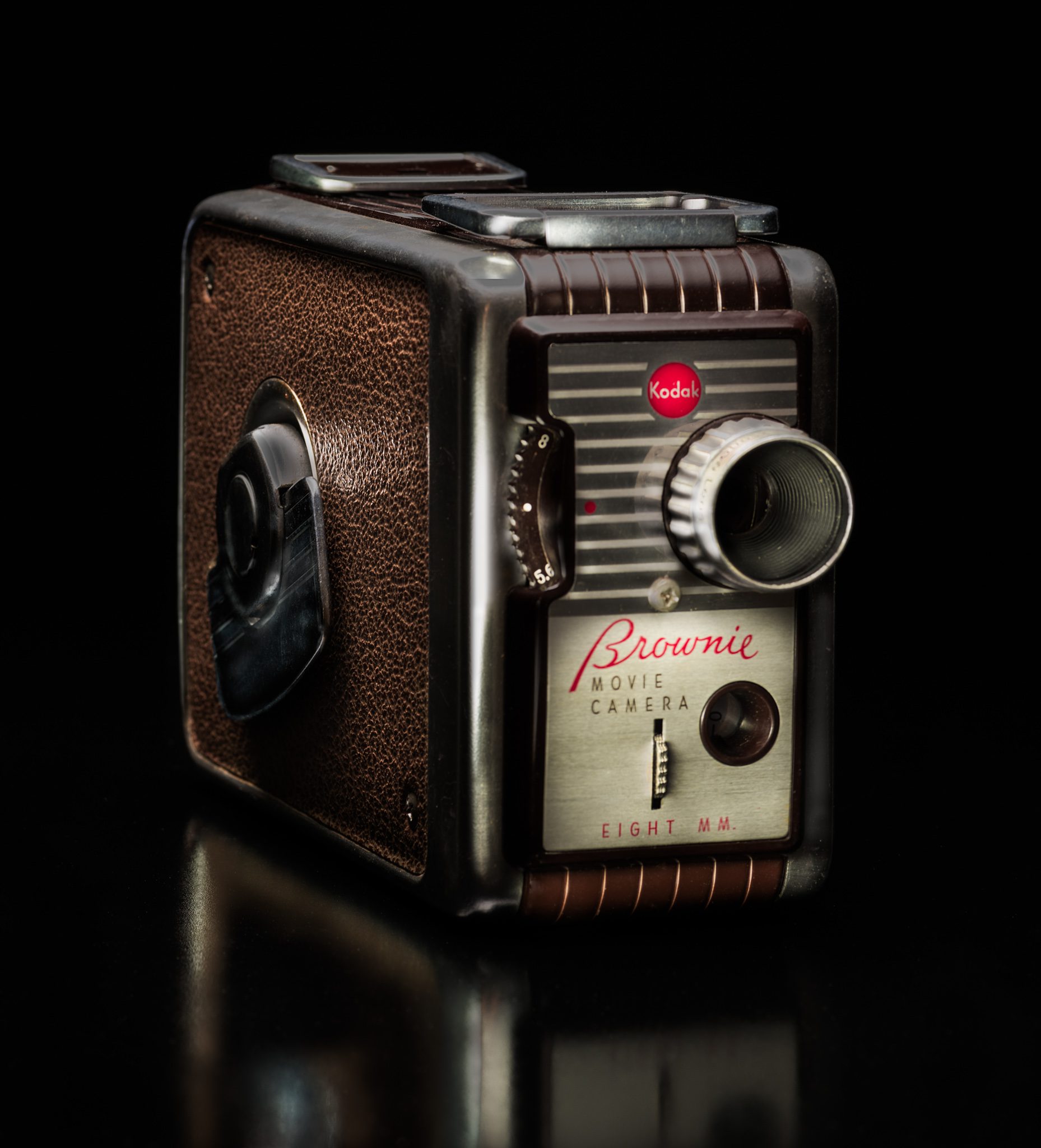
That question became especially important with Kodak Brownie Movie Camera, one of the photographs in my Objects & Memory series.
The camera belonged to my father-in-law. It brought movie recording to ordinary families by making it affordable, compact, and easy to carry. To someone else, it may simply look like an old camera. To me, it is an object I can picture in his hands, recording movies of my wife as a little girl.
Its obsolescence is part of the subject.
The photograph is not only about what the camera is. It is about the distance between the world in which it was used and the world in which I am now photographing it.
That distance can be surprisingly emotional.
We often talk about nostalgia as if it were simply a longing for the past. But I think it is more complicated than that.
Sometimes an old object reminds us that we ourselves have changed.
The technology we once learned is obsolete. The people associated with an object may no longer be here. A period of life that once felt permanent has become a memory.
The object survives, quietly carrying evidence of a world that moved on.
That is why I am careful about calling these photographs nostalgic.
I am not trying to recreate the past or pretend it was better.
I am interested in the tension between presence and absence.
The object is still here.
The time it belonged to is not.
Photography is particularly well suited to that tension.
A photograph itself is always connected to time. The instant the shutter closes, the moment it recorded has already become the past. When the subject is an old object, that relationship becomes layered.
I may photograph a decades-old camera today. The resulting photograph records the camera as it exists now, but the object points backward toward all the years before I photographed it.
The picture contains more than one time.
This becomes even more powerful when an object has a family history.
A camera, a photograph within a photograph, a hand tool, or an inherited possession carries information that is not visible to a stranger. The challenge is to make a photograph that does not depend entirely on knowing the backstory.
I want the objects to suggest that there is a story before the viewer knows what it is.
Light helps me do that.
A carefully illuminated surface can make an old object feel present again. Shadow can conceal enough information to create curiosity. Arrangement can establish relationships between things that might otherwise seem unrelated.
The still life becomes a kind of stage.
I suppose this is also why I have accumulated objects that I once would never have thought of as photographic subjects.
I look at old tools, cameras, meters, books, containers, and pieces of technology differently now. I find myself wondering where they have been, who used them, and what kind of life surrounded them.
Sometimes I know the answers.
Sometimes I do not.
Either way, the object has already survived one test: someone thought it was worth keeping.
There is something deeply human in that.
We cannot keep everything. We certainly cannot keep time itself. Houses are sold. Workplaces disappear. People move. Families change. Technology advances. The ordinary physical world of one generation becomes unfamiliar to the next.
So we save fragments.
A watch.
A letter.
A camera.
A tool.
A bowl that belonged to someone.
None of these things can give us the past back. But they can make the past briefly tangible.
Perhaps that is what I am trying to do when I photograph them.
I am not preserving the objects in the museum sense. The photograph will not prevent them from aging or being lost someday.
What I can preserve is an encounter.
For a little while, I can place the object in front of the camera, turn off the surrounding lights, and give it my full attention.
I can decide what deserves to be illuminated.
I can let the rest fall away.
And I can make a picture that says, in its own quiet way:
This was here.
This mattered.
Someone kept it.
A Question to Consider
Is there an ordinary object you have kept for years even though you no longer need it? What are you really keeping – the object itself, or the part of your life that it still carries?