
Photographing Pittsboro After Dark: My Architectural Nightscape Series
Every series starts with a single image that shouldn’t have worked.
For the Pittsboro Nightscapes, it was the Chatham County Courthouse. I was out late one evening with the camera in the car by habit. I passed the square and noticed what the light was doing to the building. Warm artificial light sat low on the facade. A deep blue still held in the sky above it. The whole thing balanced in that brief window photographers call the blue hour. I pulled over, set up, and made the shot.
It was the beginning of something I didn’t have a name for yet. A series, as it turned out. A project that’s still going.
That evening, I didn’t yet know that architectural nightscape photography would push me to develop an entirely different approach. My still life work relies on total control — a darkened room, objects arranged precisely, light introduced one exposure at a time. Nightscape work is different. It’s about reading what a place already offers and finding the technique that renders it honestly. Different problem, different tools.
This post is about what I’ve learned making Pittsboro NC photography after dark: why I’m drawn to this town, how the technique works, and what the series has taught me about the beauty of small-town spaces at night.
What Architectural Nightscape Photography Actually Means
Before I get into Pittsboro specifically, it’s worth explaining what architectural nightscape photography is. It’s also important to describe what distinguishes my approach from other forms of night photography.
The most common assumption is that a nightscape is simply a photograph made at night. That’s true as far as it goes. However, it doesn’t capture the most interesting technical possibility in this genre.
The Day-to-Night Method
The method I use is called a day-to-night transformation. First, I capture the original image in good light — usually morning or late afternoon, when architectural detail is clear. Then I transform that image in post-processing into the finished nightscape. I darken the scene systematically, reintroduce light sources selectively, and rebuild the tonal balance to reflect how the space feels after dark.
This approach has a significant technical advantage. Natural light reveals architectural texture in ways that artificial light at night often doesn’t. Think of the grain of brick, the shadow lines in cornices, the detail in window frames. Capturing that structure in good light gives me far more to work with in post-processing.
It’s also an artistic choice. A straight nighttime photograph records how a camera sensor sees a scene after dark. That’s often quite different from how the space actually feels to a person standing in it. The post-processing transformation lets me shape the image toward how the place reads emotionally. As a result, I can render the warmth of street lanterns and the soft glow of lit windows, rather than letting the physics of low-light capture constrain the result.
Why Pittsboro
For anyone who has spent time in Pittsboro, NC, the town’s character is hard to miss. It’s a place in continuous use for a long time, and that continuity shows in the built environment.
The Chatham County Courthouse anchors the square with the weight of an institution. The brick storefronts along Hillsboro Street carry the proportions and materials of another century. They’re still there, still doing what they were built to do. S&T’s Soda Shoppe has served generations of Pittsboro residents. It’s one of those businesses so woven into local memory that its presence feels geographic rather than commercial.
Alongside these long-standing fixtures, newer arrivals are finding their place. The Beagle, City Tap, Cafe Diem — each represents a different chapter of what downtown Pittsboro is becoming. Together, they create the energy of a town in transition. Pittsboro is growing faster than it has in decades, working out what growth means for a place that values what it already is.
This combination makes Pittsboro a compelling subject for architectural nightscape photography. The tension between old and new is legible in the buildings. The history is in the brick. And after dark, the light makes both the historical and the contemporary elements feel equally present — equally part of the same ongoing story.
What I Look For in a Location
Not every building in Pittsboro makes a good nightscape. Figuring out why has taught me a lot about what architectural photography is actually about.
The first thing I look for is a strong anchor — something in the frame that holds the image together and gives the eye a place to land. In the City Tap nightscape, it’s the warm glow pushing through the windows onto the sidewalk. In the Courthouse, it’s the dome and the lantern light catching the facade. An anchor doesn’t have to be the most visually interesting element. It just has to be the one that everything else relates to.
The second thing is depth — layers in the image that give the eye somewhere to travel. A flat facade photographed straight on can be beautiful, but it exhausts itself quickly. Therefore, I look for scenes with a foreground, a middle ground, and something beyond. A sidewalk leading into the frame, a receding wall, a streetlamp pulling the eye toward the background. Depth is what makes you want to look twice.
The third quality is what I can only call character — the sense that a building has been somewhere, done something, accumulated history. Pittsboro has this in abundance. The old storefronts on Hillsboro Street carry it in their brickwork and proportions. The courthouse carries it in the weight of its presence on the square. The buildings that interest me have been standing long enough to have a point of view.
The Shooting Process
Before I make a nightscape image, I walk the location in daylight. Usually I do this multiple times, in different light conditions, to understand how the architecture reads at different hours. The goal is to find the window when the building’s structural details are clearest and the available light has direction and character.
That’s typically morning or late afternoon. At those hours, the low sun angle creates raking light that reveals texture in brickwork. It also casts shadows that emphasize architectural depth. Midday light, by contrast, flattens everything it touches. I never shoot nightscape work at midday.
The actual capture is straightforward. I set the camera on a tripod, pay careful attention to composition and level, and make multiple exposures to capture the full dynamic range of the scene. I shoot in RAW to preserve maximum tonal information for post-processing.
During the walk-through, I also build a mental model of the end image. Where will the lanterns need to glow? How will the tree lights contribute to the atmosphere? Which window will carry a soft warm light suggesting occupancy? That pre-visualization shapes every post-processing decision.
Building the Nightscape in Post-Processing
The transformation from daylight capture to finished nightscape happens in Lightroom and Photoshop. For me, this is genuinely the most creative part of the process.
I start by darkening the sky and the surrounding areas. I work selectively, using masking and graduated filters to darken what should recede while preserving the detail I’ll bring light back into later.
Reintroducing Light Source by Source
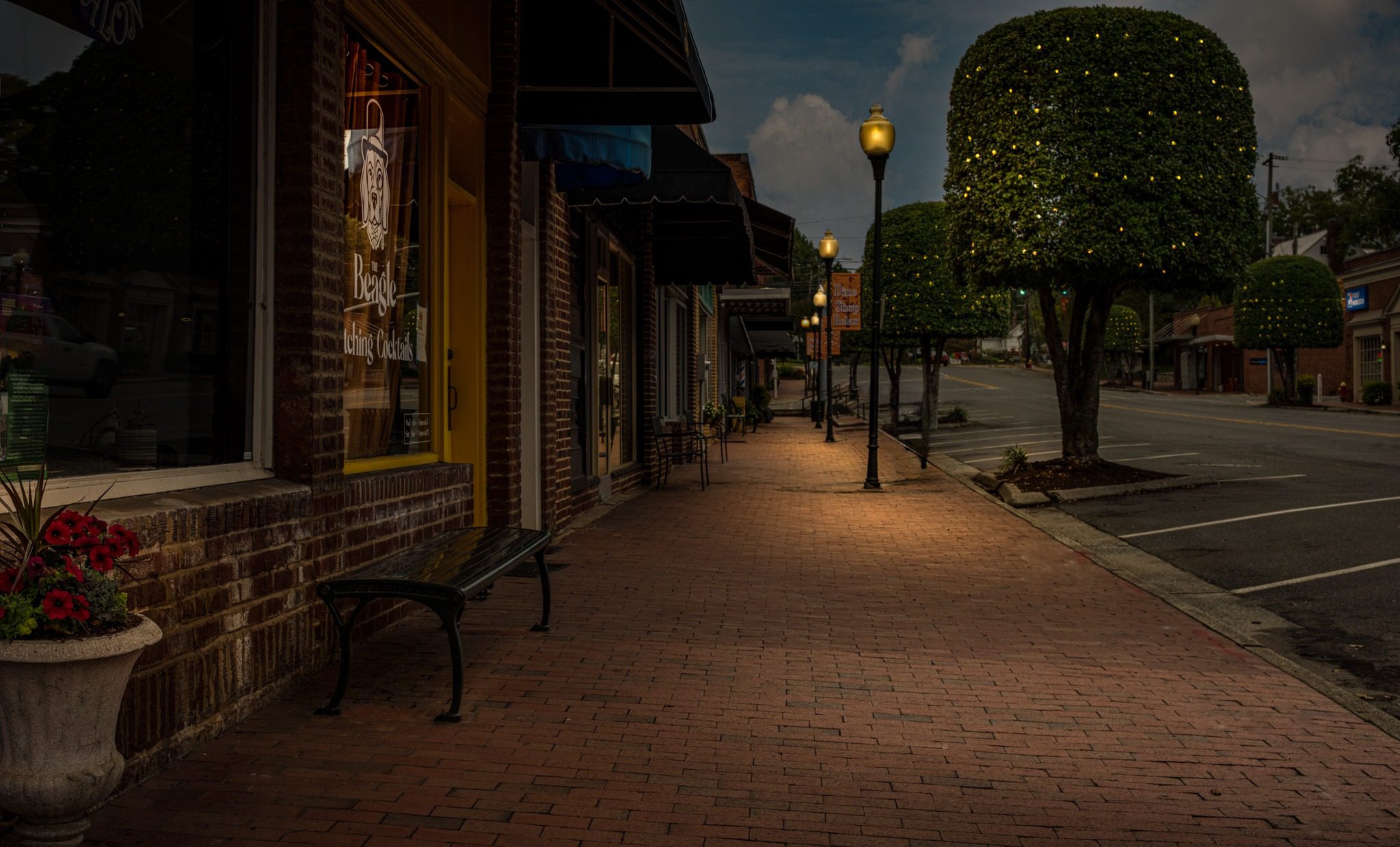
Then I begin reintroducing light. Streetlamps and lanterns are the primary sources — the elements that anchor the viewer’s sense that the scene is truly illuminated. Getting the lanterns right requires careful work at the edges of the light. The glow should feel warm and real, falling off gradually into the surrounding darkness. The halo around a street lantern, and the way warm light catches nearby surfaces — these details make a nightscape feel inhabited.
Storefront windows carry their own quality of light: softer and more diffuse, suggesting interior space. In the Hillsboro Street nightscape, for example, the lit windows along the storefronts suggest memory and continuity rather than activity and commerce. They’re lights left on, not lights turned on for our benefit.
Where tree lights appear in the scene, they contribute yet another quality — ambient and enveloping rather than directed. They soften the upper portion of the scene and connect the streetscape to the sky. Getting this right means attending to how the light diffuses as it blends into the darkness above.
Shaping the Shadows
Shadow is as important as light in this work. The areas between pools of illumination — the shadows under awnings, the darkness between storefronts — define the atmosphere just as much as the lit areas do. I shape those shadows deliberately. I preserve the texture of brick and siding within them rather than crushing everything to pure black. At the same time, I allow enough depth that the lit areas read as genuinely luminous by contrast.
What Night Does to a Town
There’s a particular transformation that happens to downtown Pittsboro after about ten o’clock on a weeknight.
The foot traffic falls away. Cars thin out. The ambient noise settles into something quieter — the occasional truck on 15-501, wind through the square, the sound of the town thinking its own thoughts. What’s left, visually, is a kind of essential version of the place. The buildings without their daytime busyness. The light without competition from the sun. The architecture without the distraction of the people moving through it.
I find this clarifying in the same way I find a darkened studio clarifying. Darkness reduces. It strips away what’s accidental and leaves what’s structural. In some sense, the building you see at midnight is more purely itself than the building you see at noon.
This is also when the light becomes interesting in the way I need it to be. Streetlamps, lit windows, the warm wash of a lantern — at night, these become the primary light sources rather than supplements to daylight. They cast real shadows. They create real contrast. They do things that flat midday light simply doesn’t do.
Pittsboro as an Ongoing Subject
I’ve been asked whether I plan to take the nightscape series to other towns. I might — eventually. But I haven’t exhausted Pittsboro yet, and I’m not sure I will.
Part of what keeps me here is local knowledge. I know which corners catch interesting light in which seasons. Which buildings stay lit and which go dark. And I know the rhythms of the town well enough to anticipate when conditions are worth going out for. That kind of knowledge takes years to accumulate and can’t be faked.
Part of it is also something harder to articulate. I feel a genuine responsibility to document this place. Pittsboro is changing — growing faster than it has in decades. The streetscape I photograph today is not what it was five years ago, and it won’t be what it is now in another five. The nightscapes are, among other things, a record.
What’s Next
There are buildings in Pittsboro I haven’t photographed yet. Some are well-known landmarks I haven’t found the right conditions for. Others are the kind of thing only a longtime resident would notice — a particular alley, a roofline that catches the light in an interesting way, a stretch of older residential streets that hasn’t changed in decades.
I also want to expand the series into the broader Chatham County landscape — historic structures, rural buildings, the architecture of a county that’s older and stranger and more layered than most people realize.
If you have a location you think I should see — in Pittsboro or anywhere in Chatham County — I’d genuinely like to hear about it. Leave a note in the comments, or get in touch. Some of the best work starts with someone saying, “Have you ever looked at that building on the corner?”
The night, as it turns out, is a very large place. I’m still finding my way through it.
This series is as much about Pittsboro’s community as it is about its buildings. If you’d like to see the nightscapes in person, prints are available through the Pittsboro Gallery of Arts, the artist-owned cooperative right on the square this series was made to honor. I’m also a member of the Chatham Artists Guild, and you can find more of my process on The Art of Light and Shadow blog.
Enjoy this kind of work?
I write The Art of Light and Shadow — stories about photography, light, and the creative process behind each image.