
People sometimes assume that because I work in a single medium — still life light painting — my work is more uniform than it actually is.
The medium is consistent. A darkened studio, a camera on a tripod, and handheld light sources illuminating the scene one area at a time. Then dozens of individual exposures, assembled in Photoshop into a single finished image. The technique is the same across every piece I make. But within that technique, I move between three distinct genres, and the differences are not just stylistic. Each genre asks a different question about what photography can hold, and each one creates a different relationship between the viewer and the image.
Understanding the three genres helps explain something that visitors to my shows often notice. A photograph of an egg can feel entirely different from a photograph of a wartime shortwave radio. Yet both come from the same darkened studio and the same technique.
Quiet Poetics: Light and Shadow as the Subject
The first genre is the one I return to most often when I need to remember why I started doing this.
Quiet Poetics is still life at its most distilled. A single flower in a bud vase, a bowl of pears. Or a porcelain coffee pot against a dark background. Wildflowers on weathered wood. An egg on a pedestal. No narrative, no symbolism, no historical reference. Just the subject, the light, and the space between them.
The name of this series comes from a quality I’m trying to achieve rather than a category of subject matter. A “poetic” image, in the sense I mean, operates below the level of explicit meaning. It creates an experience in the viewer without telling them what to think. The forsythia in the bud vase doesn’t represent anything, and the bowl of pears doesn’t comment on anything. They are what they are, and the image’s task is to make that enough.
Nothing to Hide Behind
What these images ask of me is different from what the other genres ask. There’s no story to tell, no idea to communicate. The only question is whether the light is doing something worth seeing. Is the curve of the pear rendered with enough care that the viewer feels its weight? Does the shadow behind the bud vase deepen so the flower seems to float rather than sit? And does the composition have a stillness — a genuine quietness — that invites slow looking?
It sounds simpler than the other genres. It’s not. When you remove narrative and symbol, every visual decision is exposed. There’s nothing to hide behind.
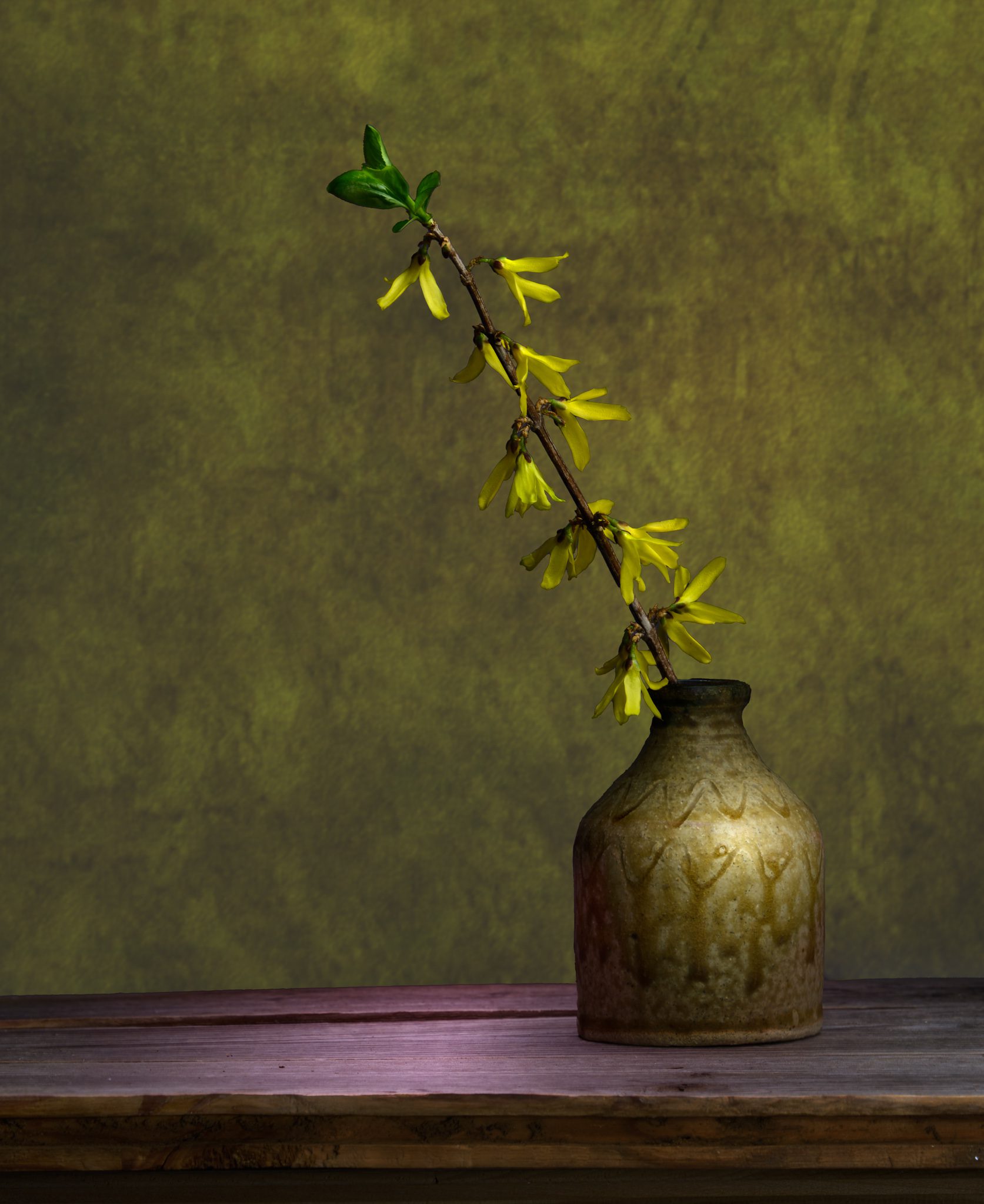
The title of this blog — The Art of Light and Shadow — comes from a Tolstoy quote. Where is that phrase most literally true in my work? Right here. In the Quiet Poetics pieces, light and shadow aren’t serving a story. They are the subject.
The Works in This Genre
This genre includes Forsythia in Bud Vase, Wildflowers on Rustic Wood, and Porcelain Coffee Pot. It also includes Blue Bowl and Pears and Egg on Pedestal. Each image represents a reduction: the fewest elements, the most essential lighting, the simplest arrangement that still feels complete. The challenge in each case was not what to add but what to leave out.
Objects & Memory: Where Engineering Meets Art
The second genre is where my history as an electrical engineer enters the work directly.
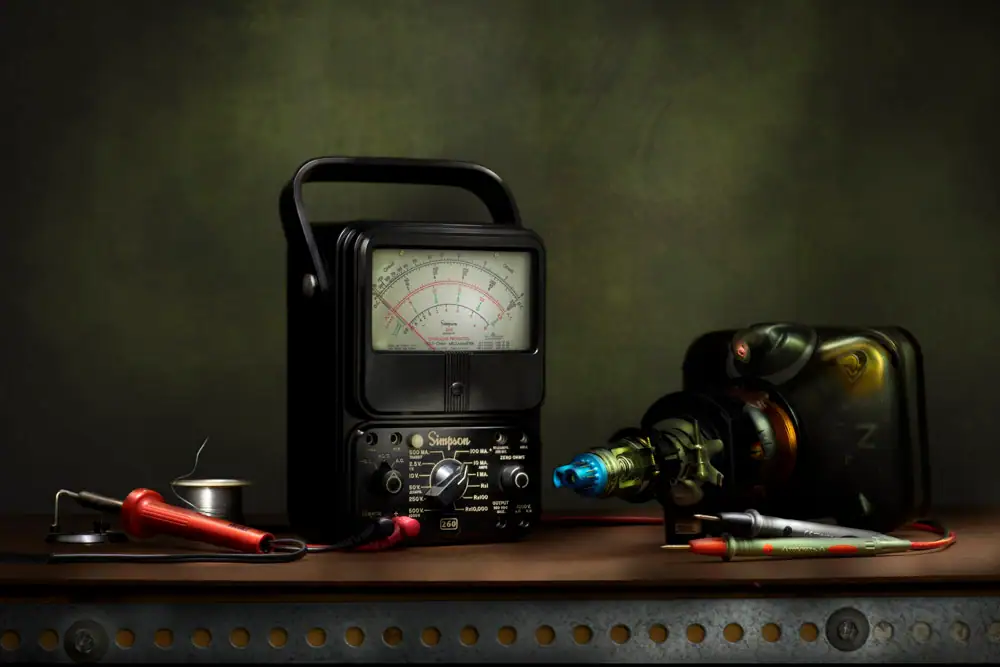
Objects & Memory is built around vintage objects that carry personal and cultural memory in their worn surfaces. Think scientific instruments, obsolete technology, and tools from mid-century trades. A Simpson 260 analog multimeter from the era when electronics was a hands-on practice, a cathode ray tube from the last generation of CRT televisions, or a soldering iron from a time when you fixed broken things rather than replaced them.
These objects share a specific quality: they are witnesses. They were present during eras now receding from living memory. The evidence of that presence lives in their patina, wear patterns, and design language. When light painting illuminates a worn surface, it renders that evidence with remarkable specificity. The scratches in a multimeter’s casing. Burn marks on a soldering iron’s tip. Faded silk-screened lettering on a piece of test equipment. In the light, these become legible as the record of a working life.
A Personal Connection
My connection to these objects is personal in a way I don’t always talk about publicly — my background is in electronics, and I came to photography through a prior life as an electrical engineer. So the instruments I photograph are not unfamiliar to me. I know what a Simpson 260 is for, and how a soldering iron feels in the hand. And I know what it means to calibrate something by turning a trimmer pot rather than hitting a button. The work connects to a version of my own formation that predates photography. That connection shows in how seriously I treat the objects I bring into the studio.
But I think these pieces resonate beyond the personal. There’s something in obsolete technology that most people recognize, even when the specific objects aren’t theirs. We’ve all watched something that once seemed permanent become unnecessary. Analog gave way to digital. Repair culture gave way to replacement culture. Tactile craft gave way to screen-mediated work. These experiences cut across specific objects and decades. The multimeter on the table is a particular thing. But it points at something more general: what do we lose when the knowledge goes with it?
Narrative: Building a Moment from Objects
The third genre is the most constructed — and, in some ways, the most demanding.
Narrative still life is scene-building. I assemble multiple objects into a composition that tells a specific story, set in a specific time and place. The characters are implied by their absence. What results is not just a subject but a moment in the middle of something.
This discipline has two requirements the other genres don’t share: research and restraint.
The research is necessary because the details have to be right. Every object in a Narrative piece has to actually belong to the world the image is inhabiting. Not just “vintage” — specifically, correctly vintage, from the right era, consistent with the particular story being told.
The restraint is necessary because the temptation to include one more layer of meaning has to be resisted. A Narrative still life should feel full without feeling crowded. The story should be readable, not decoded.
The WWII Radio Scene
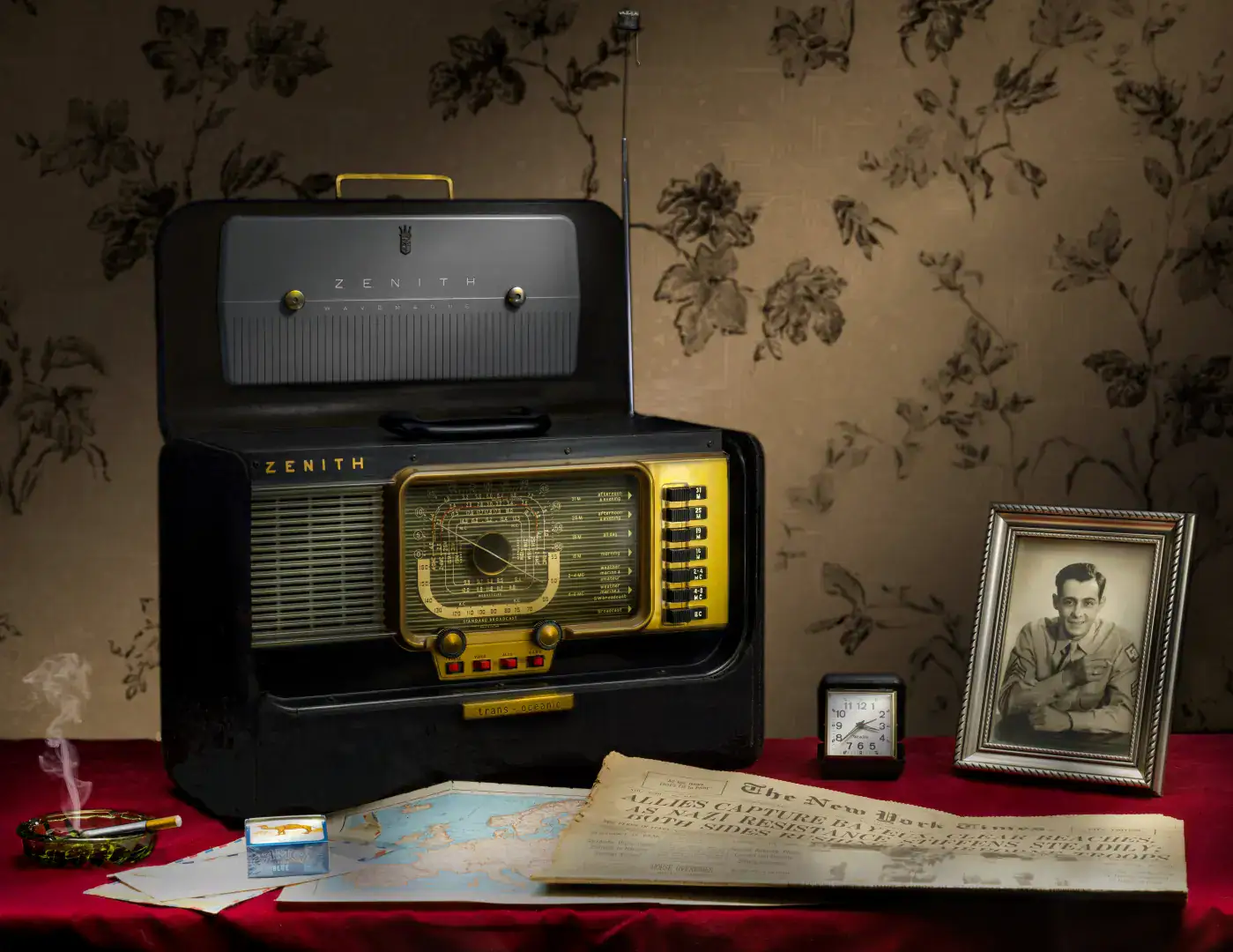
My most fully developed Narrative piece is built around a Zenith Oceanic Shortwave Radio. It is set in the early hours of June 7, 1944 — the morning after D-Day.
The scene is specific. A father in Brooklyn, unable to sleep, has been at the kitchen table since before midnight. The radio dial moves through the shortwave frequencies as he waits to hear whether his son survived the invasion of Normandy. I chose every object on the table because it belongs to that specific moment. Vintage newspapers with wartime headlines, letters from servicemen, a pack of Camels, a framed portrait. The radio sits at the center. Its warm dial is the only light in the kitchen, leaving the clock face barely visible at the edge of the frame.
Months of research came before I placed anything on the table. What kind of radio would a Brooklyn household have had in 1944? Which newspapers were available on the morning of June 7th? And what details belonged on the counter of a working-class kitchen in that era? Those questions determined which objects were right for the scene and which were merely vintage.
The result is an image that doesn’t show any person, any action, any moment of drama. But the drama is there. It lives in the position of the radio dial, the untouched coffee, and the barely visible clock. Still life photography can hold historical narrative with an intimacy that no other medium quite matches.
71 Seconds to Midnight
A more recent Narrative piece, 71 Seconds to Midnight, works from a different kind of historical moment.
The Bulletin of the Atomic Scientists maintains the Doomsday Clock to represent humanity’s proximity to global catastrophe. In 2020, they moved it to 100 seconds to midnight, partly in response to the COVID-19 pandemic. (It has since moved even closer.) My image uses a Geiger counter and a glowing red clock. Together, they evoke the anxiety of nuclear threat and the disorientation of the pandemic period. It was a time when two invisible dangers — radiation and virus — overlapped in public consciousness.
This piece is less historically specific than the D-Day radio scene. However, it is similarly built from objects chosen for precision: the Geiger counter’s clicking presence, the clock’s unnatural red light, the unease they generate together. The composition is deliberately spare — fewer elements, more tension. After all, this story is about threat rather than intimacy.
Why All Three
People sometimes ask which genre I consider my primary work. The honest answer: I don’t think in those terms.
Each of the three asks different things of me. The Quiet Poetics keeps my attention honest — it won’t let me get away with technique substituting for seeing. There is no narrative to fall back on when the image isn’t working. Either the light is doing something worth looking at or it isn’t.
The Objects & Memory work keeps me connected to where I came from. It also ties me to the cultural history that shapes what I value. These pieces are personal in ways the other genres aren’t. That investment shows in how the light treats these objects — not as props, but as things that mattered to someone.
The Narrative pieces are where I think most directly about what a photograph can hold. How much of a story, and how much of what it meant to live through a particular moment, can be compressed into a single still image?
Moving between them keeps the work alive. The same darkened studio, the same technique. Three very different conversations with the same fundamental question: what does light make visible?
Still Life Photography as a Form of Attention
Before I close, I want to say something about still life photography as a practice. I think it’s misunderstood.
People sometimes characterize still life as the most limited of photographic genres. In other words, the form you use when you can’t go somewhere interesting or find something happening. That characterization gets the logic exactly backwards.
Still life is photography stripped of the advantage of circumstance. The landscape photographer works with the spectacular; the event photographer, with the kinetic; the portraitist, with a human face that carries its own interest. Still life is different: the photographer works with objects that have no natural drama, and whatever interest they hold comes from composition, light, and arrangement.
This is not a limitation. It’s a clarification. In still life, you can see exactly what the photographer brings to the work. Nothing else in the frame is contributing. The light is there because the photographer put it there. Likewise, the composition is there because the photographer built it. And the meaning comes from the relationship between the objects, the light, and the person assembling them in the dark.
That’s what I find most compelling about the form. It’s honest about what it is.
Browse the full collection at the fine art photography gallery, or visit the work in person at the Pittsboro Gallery of Arts, 44-A Hillsboro Street, Pittsboro, NC.
Archival pigment prints of Forsythia in Bud Vase, Wildflowers on Rustic Wood, End of an Era: The Cathode Ray Tube, and 71 Seconds to Midnight are available online through Saatchi Art.
Enjoy this kind of work?
I write The Art of Light and Shadow — stories about photography, light, and the creative process behind each image.