
There’s a version of still life photography that’s entirely about the moment of light — the long exposure, the handheld source moving through a darkened room, the slow accumulation of an image on a sensor. That part of my process gets a lot of attention, and fairly so. It’s unusual, and the results don’t look like conventional photography.
But the hour before that — sometimes two hours, sometimes a whole afternoon — is where I think the real work happens. And it has nothing to do with light.
What happens before the studio goes dark determines whether a still life photograph becomes something worth making. The composition, the objects, the textural relationships, the spatial logic of the scene — all of it must exist before the camera opens its shutter. In most photography, post-processing can partially rescue a weak composition. Light painting still life doesn’t offer that escape. Once the room goes dark, you’re executing the arrangement you built. The darkness doesn’t forgive a weak foundation.
This is the part of the process I want to walk through here: how a still life scene comes together, from the first idea to the moment the lights go out.
It Starts With a Sketch
Before I build a set, before I select a single prop, before I have a camera anywhere near the process, I make a sketch.
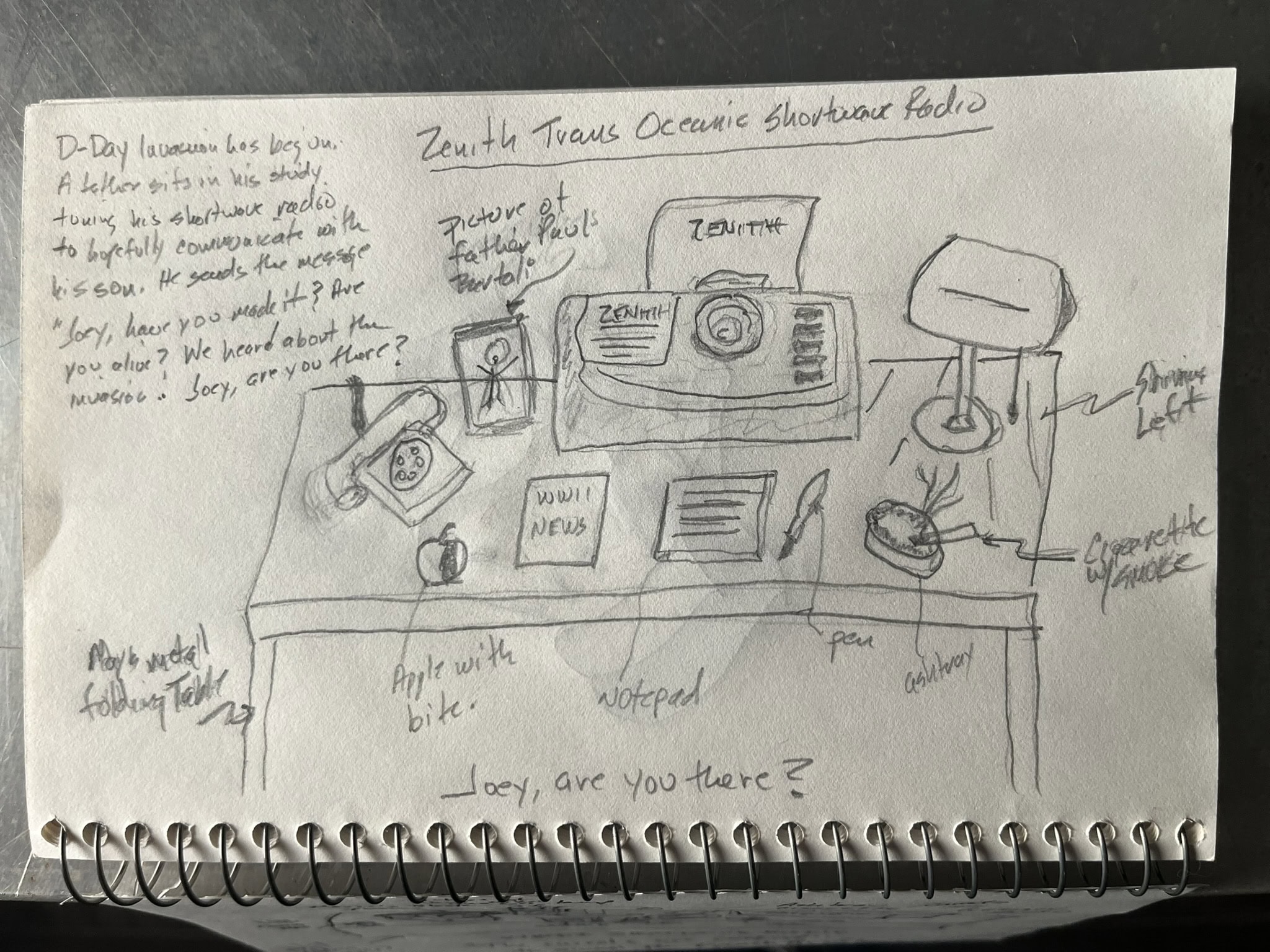
It doesn’t have to be elaborate. Sometimes it’s a few lines — the rough mass of the main subject, the edge of a shadow, a note about where the viewer’s eye should enter and where it should rest. But drawing forces a kind of clarity that working in three dimensions doesn’t. A sketch is a commitment. It’s a record of a decision made before any investment of time or materials.
This practice comes directly from painting rather than from photography. Painters work in studies. They establish composition on paper before they touch the canvas. My colleagues at the Pittsboro Gallery of Arts work this way as a matter of course. They know that the problems you don’t solve in the drawing will still be there when the paint goes down — only harder to fix.
For still life light painting, this discipline is especially important. The exposure itself is essentially irreversible. Once the room goes dark and the shutter opens, I’m executing the plan I’ve already made — not making new decisions. If the drawing was wrong, the photograph will be wrong too. The only remedy is to start over.
The sketch also functions as a reference point. Midway through building a set, the scene will start drifting from the original vision. Which it will. The gap between the arrangement you imagined and the one your hands build on a real surface is where most of the work lives. The sketch is the anchor.
Where Objects Come From
The objects in my still life work come from many places, and how they arrive matters.
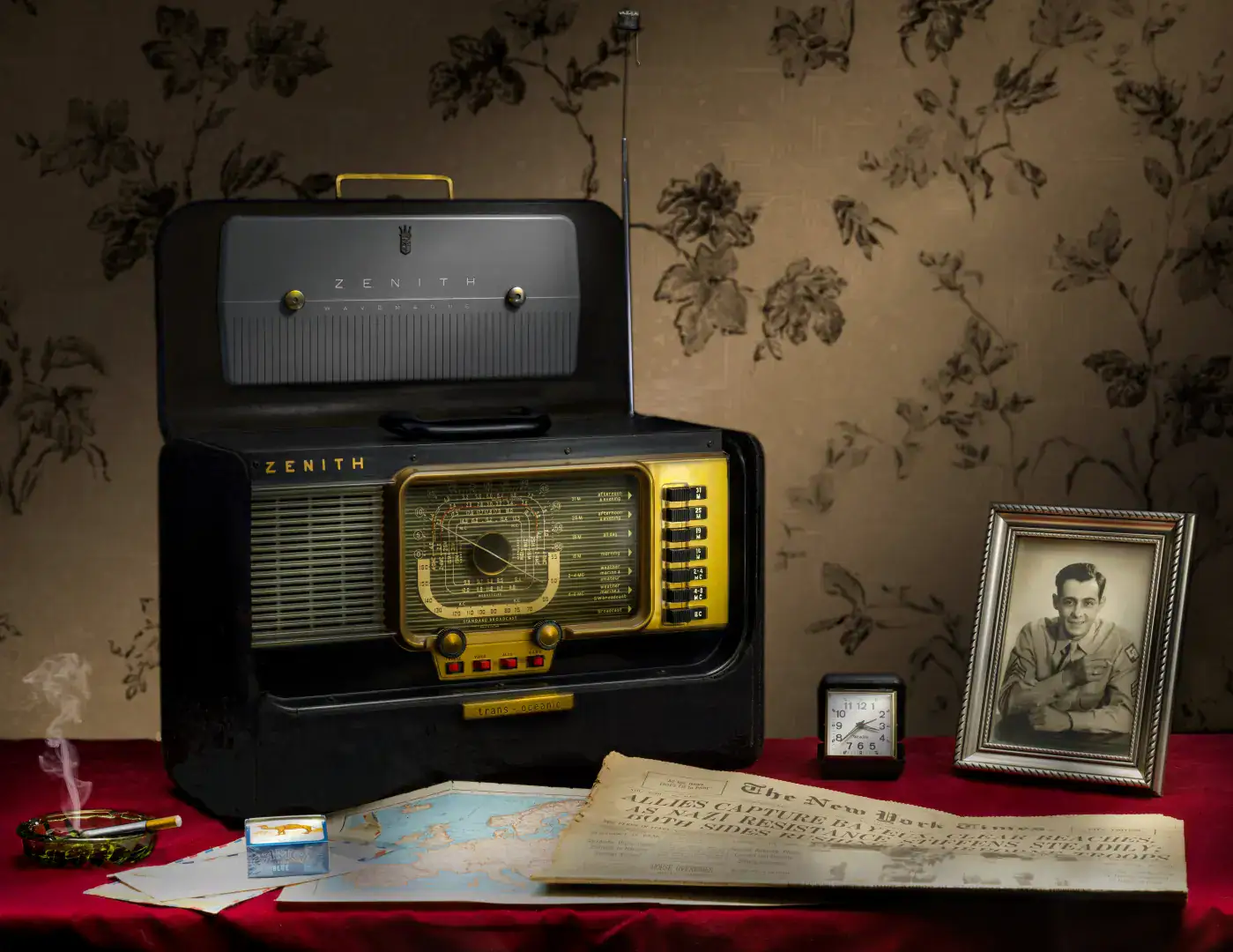
Some come from estate sales and antique shops — discovered rather than sought. These are the objects that have earned their age. A Simpson multimeter carries the patina of decades of calibration work. A Zenith Oceanic shortwave radio shows the wear patterns of someone who actually used it. A CRT television speaks in the design language of an era now fully past. The evidence of use is not something I try to eliminate. It’s the quality I’m looking for.
Objects with Provenance
Some come from friends and acquaintances who know the kind of things I’m interested in. Someone mentions that their grandfather’s soldering iron is still in a drawer somewhere. Someone else has letters from a serviceman they’re willing to loan for a shoot. These objects carry provenance in the literal sense. They have a specific history, and that history is legible in their surfaces.
Some come from my own collection — built up over years in electronics and engineering work. These tend to be the objects that sit at the center of what I call the Objects & Memory genre: tools and instruments from mid-century trades that I know personally, that connect to my formation as a technician before I was a photographer.
What all these sources share is that the objects arrive with something already in them. My job in the studio is to find out what that something is and build a scene around it — rather than importing a neutral object and trying to give it meaning from scratch.
The Table as a Problem to Solve
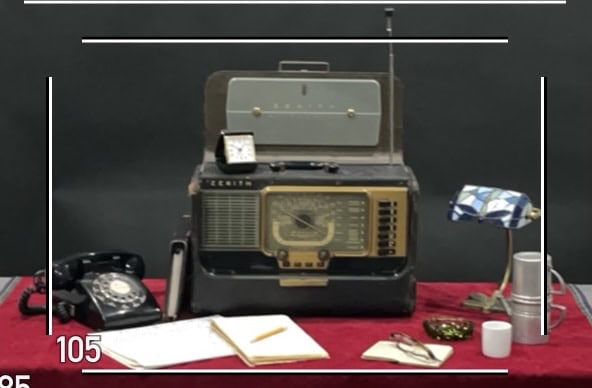
When I begin setting up a scene, I’m working with a specific kind of constraint: I have a central object, I have a feeling I want the image to carry, and I have a table. Everything else is a decision.
The first question is always the same: what does this object need around it? Not what looks good with it — what it actually needs in order to make sense. There’s a difference. Objects that merely look good together produce a decorative image. Objects that belong together produce something with more weight.
For a piece in the Quiet Poetics genre — a bud vase with forsythia, a bowl of pears, a porcelain coffee pot — the question is about simplicity. What’s the minimum number of elements that creates a complete visual statement? These pieces often become stronger as things come off the table rather than being added to it.
For a Narrative piece — the WWII radio scene, the Doomsday Clock tableau — the question is about specificity. What does this particular moment, in this particular time and place, actually contain? The objects have to belong to the world the image is inhabiting, not just approximate it. A newspaper from 1944 matters. A generic vintage newspaper doesn’t.
This distinction takes time to feel rather than think your way through. I’ve learned to trust a kind of visual unease — the slight wrongness that registers when something on the table is there because it’s interesting rather than because it belongs. Those things come off the table.
Thinking About Texture Before Light
Before I place a single light, I spend a lot of time thinking about surfaces — specifically, what happens to different materials when light rakes across them at a low angle.
Still life light painting renders texture with an intensity that flat or overhead lighting can’t match. The grain in a piece of wood. The slight roughness of aged paper. The patina on a brass fitting. These become almost sculptural in the finished image. That’s one of the most distinctive qualities of the technique.
So I compose with texture as much as I compose with form. A smooth glass object next to a rough wooden surface creates a contrast the light will emphasize. A matte surface next to a reflective one will catch the same light entirely differently. A piece of weathered cloth next to a polished instrument reads in two completely different registers.
I think about these relationships first. Once the room goes dark, what I’ve built on the table is what I’m committed to. The textures are already there. The light will find them. My job in the setup phase is to make sure what the light finds is worth rendering.

Controlling the Path of the Eye
Composition in still life is fundamentally about controlling the path the viewer’s eye takes through the image.
I want the eye to enter the frame, move through it, and come to rest somewhere — not exit off one edge and leave. To do that, I think about mass and weight: heavier or taller objects pull the eye, so I place them to redirect attention back toward the center rather than off toward a corner.
Depth, Focus, and Negative Space
I think about depth — layering objects at different distances from the camera so the image has somewhere to go. A still life that presents everything at the same distance from the lens is a lineup, not a scene. The foreground should differ from the middle ground, which should differ from what recedes behind.
I think about what’s sharp and what softens. Depth of field is one of the most powerful compositional tools in close-up work. Selective focus creates a visual hierarchy separate from the arrangement itself — where the eye looks first is often where the focus lives.
I think about negative space — the areas around and between objects that nothing fills. Empty space isn’t absence. It’s breathing room and visual rest. The composition should have enough of it to let the subject exist with some air around it.
If I can follow the path of my own eye for thirty seconds without losing interest or running off the frame, the composition has at least a chance of working.
Backgrounds, Surfaces, and Light Behavior
The surface a scene is built on, and the background behind it, are as important as the objects themselves. Both interact with the light in specific ways that the composition depends on.
I work almost exclusively with dark backgrounds that give the light somewhere to fall away into. A very dark background — almost black, but not quite — holds shadows without flattening them. It gives the lit objects a sense of emerging from depth rather than sitting in front of a wall. This connects still life light painting most directly to the chiaroscuro tradition: the sense that light reveals something that would otherwise remain in darkness.
The surface the objects rest on carries its own visual weight. Weathered wood reads differently from stone, which reads differently from plain canvas or cloth. Each catches raking light differently. Each creates a different sense of age and character in the finished image. For the Objects & Memory genre, I often look for surfaces whose age and wear match the age of the objects on them — visually and historically, they belong to the same moment.
Living With It
Here’s the part of my process I rarely talk about: I don’t shoot the scene the same day I build it.
I set up the arrangement. I look at it for a while. I walk away. I come back an hour later, or the next morning, and look again with fresh eyes — the eyes of someone encountering it for the first time, not the eyes of someone who just finished placing every object.
Those two views are very different. What felt complete in the late afternoon often looks cluttered by the next morning. Something fights for attention that shouldn’t. Or the opposite: the scene feels empty in a way that wasn’t obvious while I stood over it. One object too many, or one too few.
I’ve stripped entire scenes down and rebuilt them from scratch after living with them for a day. I’ve also walked back in and removed exactly one object — and had the image lock into place.
This patience isn’t natural to me, exactly. It’s a discipline the work demanded, and I’ve come to trust it. The still life photographers and painters I admire most all share this willingness — staying with a setup long enough to actually see it rather than just execute it.
When It’s Ready
There’s no definitive signal that a scene is ready to shoot. What I’ve learned to recognize is more like an absence of doubt — a point where I stop fidgeting with the arrangement and just look at it.
Sometimes that point comes after twenty minutes. Sometimes it comes after three sessions spread across two days. The time it takes has nothing to do with how complex the scene is. It’s a function of how long it takes to feel genuinely settled about every element in the frame.
That’s when the lights go out.
What the Darkness Inherits
Everything I’ve built on the table — every textural relationship, every compositional decision, every object that earned its place — now exists only in my memory. The camera sees it; I don’t. What happens next is a different kind of work entirely. A long series of exposures in the dark, each one illuminating a different part of what I’ve built, each one adding another piece of light to the image that will eventually emerge from Photoshop.
But it only works if the foundation is solid. The darkness doesn’t forgive a weak composition. It just removes your ability to notice it.
The Still Life Setup: A Summary for Photographers
If you’re looking to build your own light painting practice, here is how I’d describe the setup priorities in order of importance:
The central object comes first and everything else responds to it. Don’t fill the table and then look for a subject — find the subject and let it determine what it needs.
Textural relationships matter more in light painting than in any other form of still life photography. Think about contrast between smooth and rough, matte and reflective, old and new, before you think about color or arrangement.
Depth is the difference between a scene and a lineup. Layer objects at different distances from the lens.
Negative space is not empty. It’s the composition breathing. Leave room for it.
Time is the ingredient most photographers underestimate. The scene you build on day one is rarely the scene worth shooting. Living with it changes what you see.
For what happens once the studio goes dark — the full light painting capture process, the Photoshop assembly, and how the finished image comes together — read What Is Light Painting Photography? For the stories behind specific objects in the studio, Behind the Light is a good companion.