
When I tell collectors that a fine art archival pigment print can last 200 years or more, I sometimes get a skeptical look. It sounds like marketing. It isn’t. Once you understand the materials, the claim makes sense. In fact, knowing why prints last — or why they fail — is one of the most useful things a collector can learn.
The gap between an archival print and an ordinary one is not about price or prestige. It is a material difference and a chemical difference, and it changes what you are acquiring. One is an object built to outlast its owner. The other is a picture that will look fine for a while and then begin to go. You should know which one you are buying.
This post covers the materials behind archival pigment printing: the ink chemistry, the paper, and the glazing. Each element matters for what ends up on your wall.
What “Archival” Actually Means
“Archival pigment print” is a phrase you will see on gallery labels, in artist statements, and in listings, and it is worth knowing that it describes something specific rather than serving as a compliment the seller pays their own work.
An archival print is one made so that the image will not measurably change for a very long time under normal display. That requires three things to be true at once: the ink must be pigment rather than dye, the paper must be chemically stable and free of the compounds that cause paper to yellow and embrittle, and the glazing over it must block ultraviolet light. Miss any one of them and the print is not archival, whatever the label says.
An ordinary print fails on all three counts, and it fails quietly. It is made with dye-based inks on standard, usually wood-pulp paper, and it is framed behind whatever glass came with the frame. Dye inks are vivid and economical, but chemically fragile under light and humidity. Hang that print near a window and it will show fading within a few years. Within a decade the color shift is obvious — but by then you have looked at it every day and the drift is invisible to you. People rarely notice their prints fading. They notice years later, when they see the original again.
So why the price difference? Cotton rag paper costs many times what standard photo stock costs. Pigment ink sets cost more than dye. Conservation glazing costs more than window glass. The materials are most of the price — not a premium for prestige.
Two different objects: an archival pigment print on cotton rag, and an ordinary print on standard stock
Two different objects: an archival pigment print on cotton rag, and an ordinary print on standard stock
Pigment Inks vs. Dye Inks: The Chemistry That Determines Longevity
The split between pigment and dye inks is a chemical one. More than anything else, it determines how long a print holds its color.
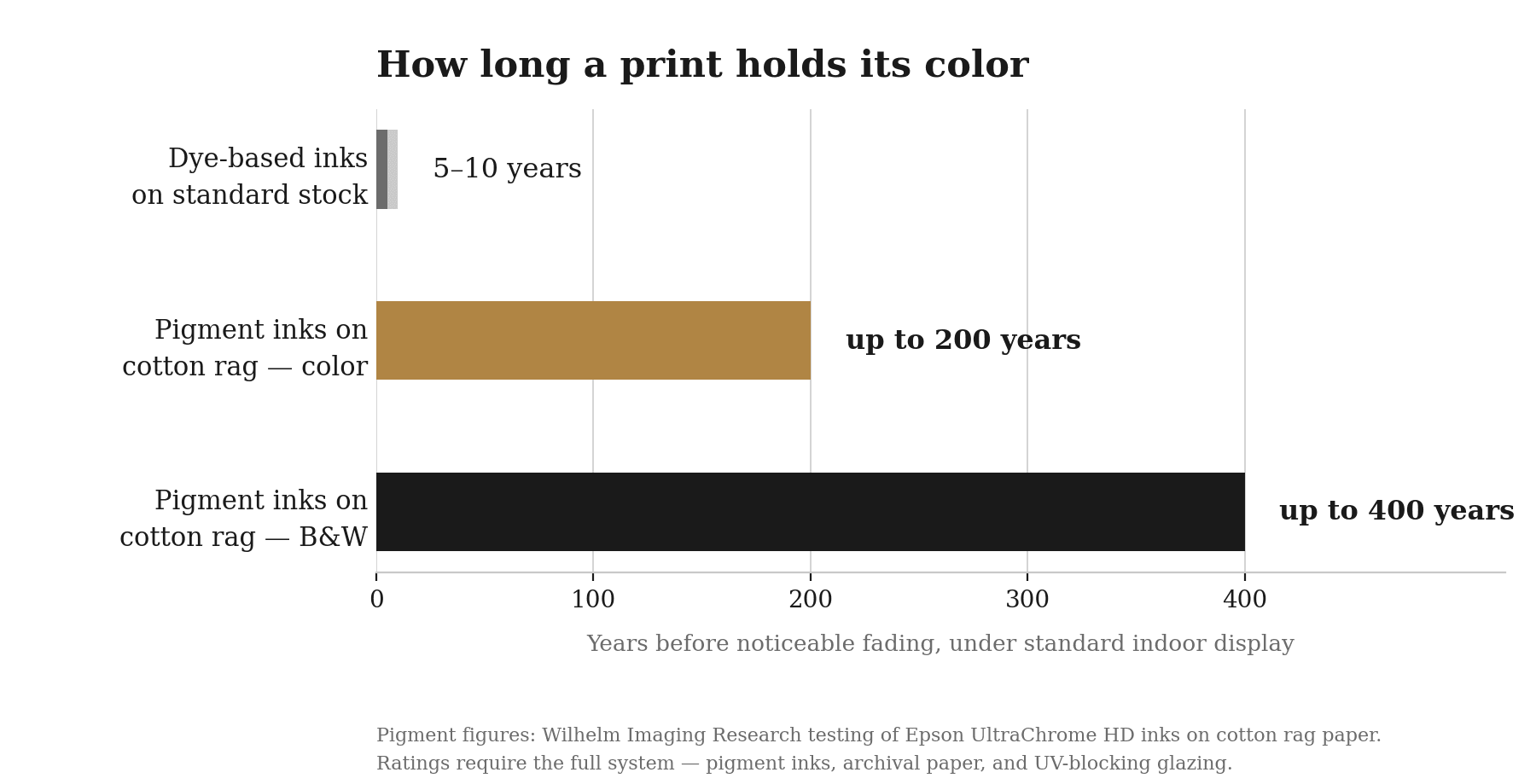
Dye-based inks dissolve color molecules into a liquid carrier. The dissolved molecules are small, so they soak deep into the paper fibers. That produces brilliant, saturated color. The problem is that dissolved molecules are fragile. Light — especially UV light — breaks the bonds that create the color. Colors shift, highlights yellow, and shadows flatten. The change is gradual at first, then obvious. Under normal display conditions, a dye-based print can fade noticeably within five to ten years.
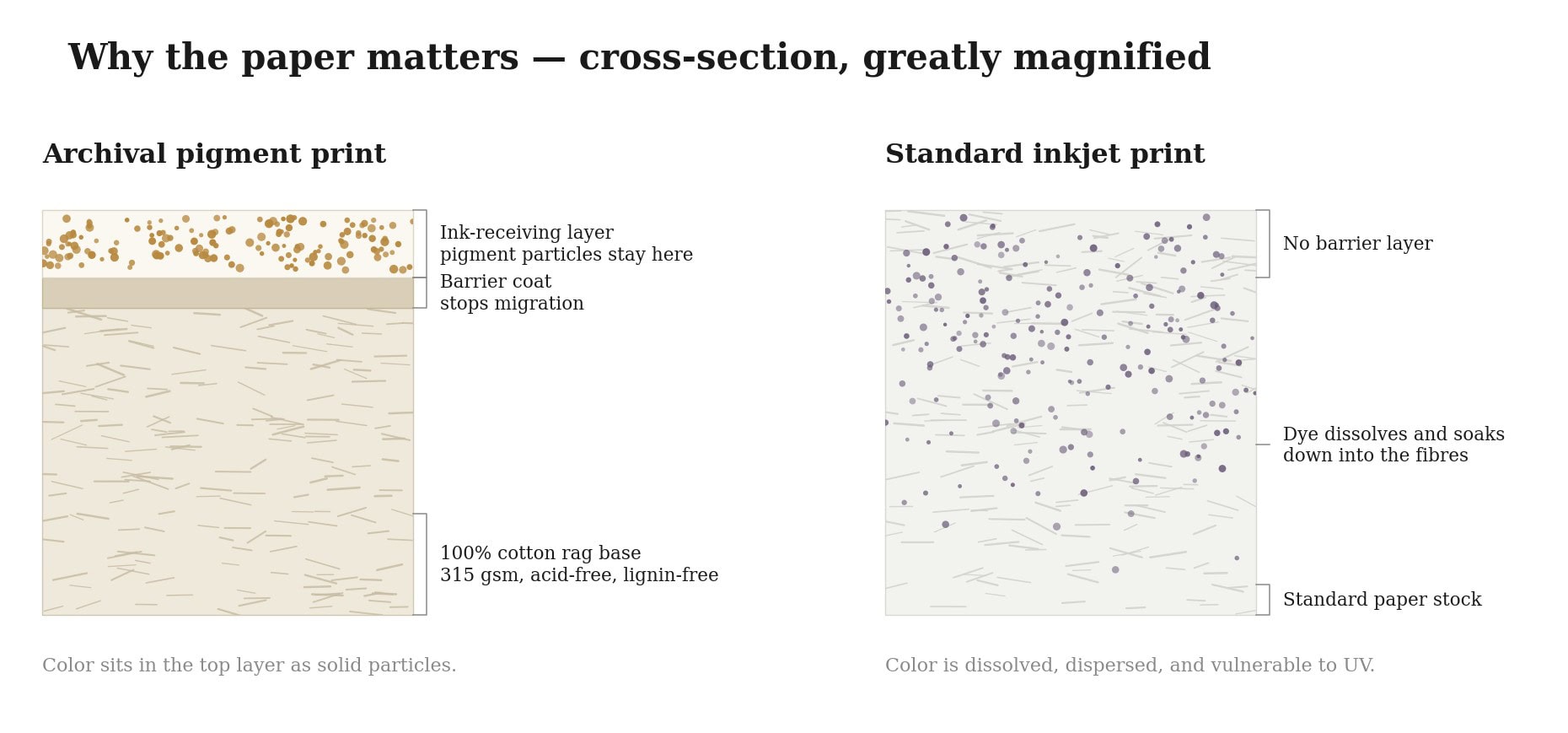
Pigment-based inks work differently. Instead of dissolving the color, they suspend microscopic solid pigment particles in liquid. Those particles stay intact and sit on the paper surface rather than soaking in. Because the color exists as stable solid particles, it stands up to light far better than dissolved dye.
Independent Testing, Not Marketing Claims
I make my prints on an Epson SureColor P-800 with Epson UltraChrome HD pigment inks. Wilhelm Imaging Research, the world’s leading authority on print permanence, tested this system independently. Their rating: up to 200 years for color prints and up to 400 years for black-and-white prints under standard indoor display. These are not manufacturer claims. They come from accelerated lightfastness testing by a laboratory with no financial ties to Epson.
The Full System Matters
One important caveat: longevity requires the full system. Pigment inks on cheap paper will not reach those ratings. Neither will archival paper behind the wrong glazing. The inks, the paper, and the glazing work together. Compromise any one element, and the lifespan drops sharply.
The Paper: Red River Palo Duro SoftGloss Rag 315
The paper matters as much as the ink, so it deserves its own explanation.
Cotton rag paper has been the archival standard in fine art for centuries — long before photography existed. The drawings and prints that survive from the Renaissance were made on cotton rag. They lasted because cotton fiber is chemically stable in a way that wood-pulp paper is not.
Conventional paper comes from wood pulp, which contains lignin. Lignin is the compound that turns old newspapers yellow and brittle. Even in dark storage, lignin-based paper breaks down over decades. Cotton rag contains no lignin. It is acid-free and chemically neutral, so it does not contribute to its own decay.
Why This Specific Paper
I print on Red River Palo Duro SoftGloss Rag 315. At 315 gsm, it is a substantial sheet — heavy in the hand in a way that signals quality. It is 100% cotton rag, acid-free, and lignin-free. It also contains no optical brighteners. Those are the additives that make cheap papers look artificially white. Under UV exposure, brighteners break down, and the paper yellows.
The soft gloss surface comes from a barrier coat between the cotton base and the ink-receiving layer. This barrier keeps the pigment locked in the top layer instead of letting it sink into the fibers. The payoff is deep, rich blacks. For light painting work, that depth is critical. The relationship between the darkest shadows and the most delicate highlights is what creates the mood of the image.
The Darkroom Look, Without the Glare
The soft gloss finish achieves something a fully glossy surface cannot. It has the depth of a traditional darkroom fiber print, but without the mirror-like reflections that make glossy paper hard to display. Photographers who learned in darkrooms recognize this look immediately. The blacks have the same quality, and the tones seem to sit inside the paper rather than on top of it. Now that look comes with pigment inks that will outlast any traditional photographic process.
The soft gloss surface: darkroom depth without the mirror-like glare
The soft gloss surface: darkroom depth without the mirror-like glare
Glazing: The First Line of Defense
Even a perfect archival print will fade behind the wrong glazing. UV light is the main cause of fading in displayed works on paper, and it is present in sunlight and many artificial lights. The glazing is the first line of defense.
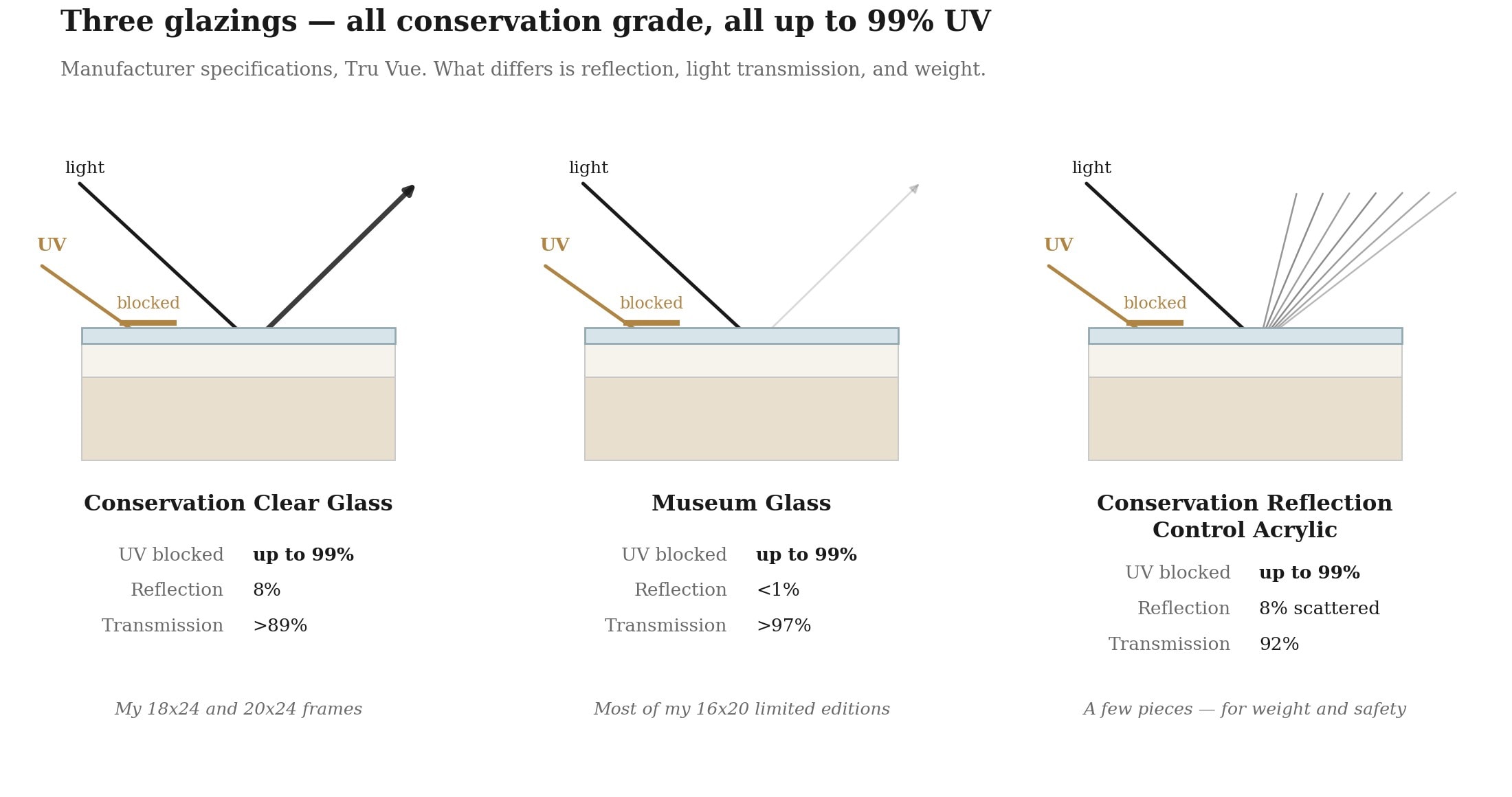
I work with three options, all of them Tru Vue conservation grade, and all three block up to 99% of UV. The differences lie in how they handle reflection, how much light they let through, and what they weigh.
Conservation Clear Glass
Conservation clear glass blocks up to 99% of UV through a permanently bonded coating. It does the most important job — blocking UV — reliably and permanently. What it lacks is an anti-reflective coating: at 8% surface reflection, you will see the room in it under ambient light. Light transmission is above 89%.
For rooms with controlled lighting, away from windows, it is a fully sound conservation choice, and it is the most economical of the three. This is what I use on my larger pieces, the 18×24 and 20×24 frames, where museum glass becomes expensive at scale. If your space lets you avoid reflections, it protects the print exactly as well as museum glass does.
Museum Glass
Museum glass adds a double-sided anti-reflective coating to the same up-to-99% UV protection. Surface reflection drops below 1%, and light transmission rises above 97% — which is why the image looks brighter as well as clearer. In person the effect is remarkable: the glass nearly disappears, and the artwork seems to sit in open air.
This is the standard for gallery and museum installations, and it is what I use on most of my 16×20 framed pieces. It also costs the most, because coating both surfaces with that precision is difficult to manufacture. Museum glass is the right choice where room light or window light would cause distracting reflections. Have you ever shifted around a framed photo, hunting for an angle where you can actually see the image? Museum glass solves that problem completely.
Conservation Reflection Control Acrylic
Conservation reflection control acrylic solves a problem glass cannot: weight. Beyond a certain size, glass becomes impractical — heavy to hang, fragile to ship. Acrylic is a fraction of the weight and far harder to break, which matters in high-traffic rooms and in shipping.
Its UV protection is different in kind from the glass options. Rather than a surface coating, the UV filter is in the substrate itself, so it cannot wear, scratch off, or degrade at the edges. Tru Vue’s accelerated aging test ran 2,000 hours of xenon-arc exposure at 100,000 lux — roughly a century of display — with its properties unchanged.
The matte finish scatters light to cut glare, at 8% scattered reflection and 92% light transmission. It does not match the full anti-reflective effect of museum glass; you notice a slight diffusion. Still, for work where weight, safety, and conservation all matter, it is the right choice.
One caution if you are specifying acrylic yourself. Tru Vue makes a Reflection Control acrylic and a Conservation Reflection Control acrylic, and the names are close enough to be genuinely confusing. The standard version blocks only up to 66% of UV and is intended for items that are not sensitive to UV damage. The conservation version blocks up to 99%. Ask for it by its full name, and check that the datasheet says the substrate is UV filter acrylic rather than framing grade.
Why the Prices Differ
The price gaps reflect real manufacturing differences. Conservation clear glass is the simplest to produce. Museum glass needs precision anti-reflective coating on two surfaces, which is why it costs the most per square foot. Conservation-grade acrylic, with the UV filter carried through the sheet rather than applied to it, is simply an expensive material to make.
What This Means for a Print on Your Wall
A photograph is an investment in two senses. There is the price you pay now, and there is the value — financial and emotional — you want it to hold over time.
An archival pigment print is designed to hold that value. The cotton rag paper, the pigment inks, and the conservation glazing are not upgrades layered onto a standard product. They are what the work is made of. That is why I can say the print should outlast the people who hang it.
An ordinary print, however good it looks in its first year, is not built for that. It will change over time in ways an archival print will not, and it will do so slowly enough that you are unlikely to catch it happening.
If you are choosing art for a wall you care about — a space you live in, where you will see the work for years — that distinction is the one worth asking about. Every print I sell is made the same way, on the same printer, the same pigment inks, and the same cotton rag paper, because I would rather not sell anything I would have to qualify.
Frequently Asked Questions About Archival Prints and Longevity
What is a Wilhelm Imaging Research rating?
Wilhelm Imaging Research is the independent lab that pioneered standardized testing for print permanence. Their ratings use accelerated lightfastness testing to predict how long an ink-and-paper combination stays stable. For example, a 200-year rating means no visible fading for 200 years under standard indoor display. That standard assumes no direct sunlight and about 12 hours of normal artificial light per day.
Does archival paper prevent all fading?
No single element prevents fading on its own. Longevity requires the complete system: pigment inks, archival paper, and UV-blocking glazing. Archival paper without UV glazing will still fade in the light. Likewise, pigment inks on non-archival paper will suffer as the paper degrades.
How should I care for a fine art print in my home?
Keep it out of direct sunlight and away from very humid rooms, such as bathrooms. Normal indoor humidity and temperature are fine. The UV glazing does the primary protective work. If you move or store the piece, avoid leaning anything against the glazing.
Can fine art prints be re-matted or re-framed?
Yes. The print itself is a stable, archival object. A professional framer can re-mat and re-frame it as many times as needed. Just make sure the framer uses acid-free mat board and conservation-grade glazing.
What is a Certificate of Authenticity and why does it matter?
A Certificate of Authenticity is a document signed by the artist. It identifies the specific print — title, edition number, print date, and materials — and establishes provenance. In other words, it connects the physical object to its origin. For collectors who care about future value, it makes that connection verifiable.
Browse the full collection at the fine art photography gallery, or visit the work in person at the Pittsboro Gallery of Arts, 44-A Hillsboro Street, Pittsboro, NC.
Selected still life prints are also available to purchase online through my Saatchi Art profile.
Enjoy this kind of work?
I write The Art of Light and Shadow — stories about photography, light, and the creative process behind each image.