
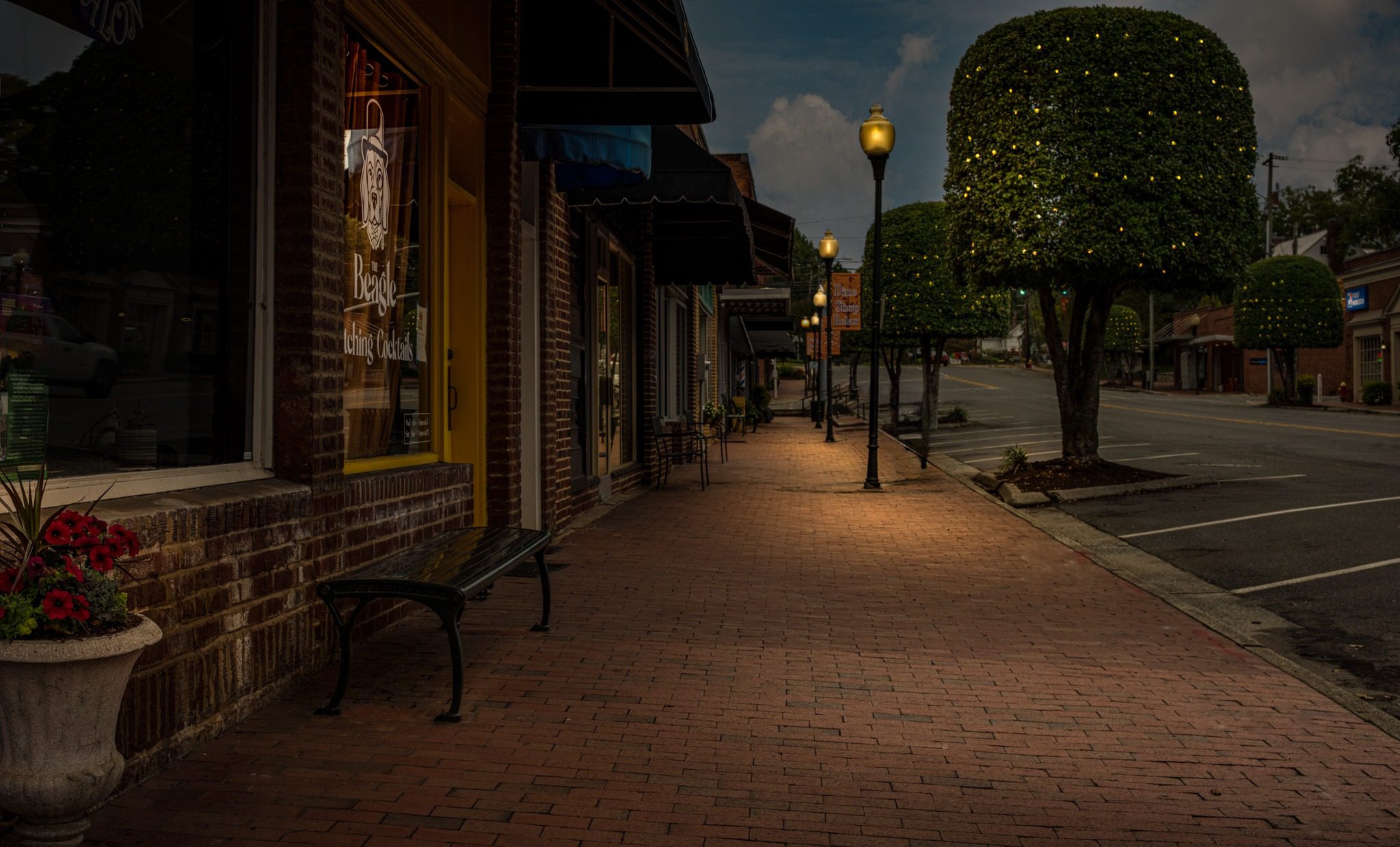
Hillsboro Street Pittsboro: Creating an Interpretive Nightscape
A Street That Became Part of My Life
A Street That Became Part of My Life
Hillsboro Street in Pittsboro has lived in my imagination for a long time, and it eventually became the subject of Hillsboro Street After Dark. Most people know Hillsboro Street Pittsboro as the main street through downtown: brick storefronts, brick sidewalks, old lanterns, and the easy rhythm of a small town.
But when I look at Hillsboro Street, I see more than architecture. I see memories.
Over the years, my family and I have enjoyed going to the S&T Soda Shop for ice cream. When our grandchildren came along, we took them there too. Those outings were simple, but that is often how a place becomes important to us. A walk downtown, an ice cream cone, time together – repeated often enough that the street itself becomes part of the memory.
Hillsboro Street has also become part of my artistic life. Across the street is the Pittsboro Gallery of Arts, the artist cooperative where I exhibit my work. I spend time there with other artists, talk with visitors, and watch people respond to art. Family life and artistic life meet for me on this street.
That is why I wanted to make a photograph of Hillsboro Street that was more than a record of what happened to be in front of my camera. I wanted to make an image that reflected how the place feels to me.
The Photograph I Wanted Didn’t Exist
The finished image looks as though I photographed Hillsboro Street at night. I didn’t.
I photographed it during the day, early in the morning, when the street was quiet and there was enough light to capture the detail in the architecture. I wanted the bricks, windows, storefronts, and textures to be clearly recorded. Daylight gave me the raw material I needed.
But the daylight photograph was only the beginning.
The image I had in mind was a nighttime scene: quieter, a little mysterious, with pools of warm light drawing attention to certain parts of the street while other areas slipped into shadow. That photograph wasn’t waiting for me to find it. I had to create it.
That is why I call this work an interpretive architectural nightscape. The architecture is real. The street is real. But the light is my interpretation.
Creating an Interpretive Nightscape of Hillsboro Street in Pittsboro
Once I had the daylight photograph, I began transforming the scene. I could decide where a window should glow, where a street lantern should become more prominent, how warm or cool a light should feel, and even how the shape of that light should fall across the architecture.
I wasn’t trying to reproduce the lighting that happened to exist on Hillsboro Street on one particular evening. I was composing with light.
That distinction matters to me. A camera is very good at recording what is there. But I am not always interested in stopping at the record. Sometimes I want to ask what the photograph could become if I place the light where I want it, allow shadow to remain where it adds something, and guide the viewer through the scene deliberately.
Light reveals, but it also directs attention. Shadow does something equally important. It quiets parts of the image and leaves room for the imagination. If every brick, window, and storefront demanded equal attention, the photograph would have no place for the eye to rest. Choosing what not to emphasize is part of making the image.
How Hillsboro Street After Dark Connects to My Still-Life Photography
While working on Hillsboro Street After Dark, I realized how closely these architectural nightscapes are related to my light-painted still lifes.
At first, the subjects seem completely different. In the studio I may be photographing a flower, a pear, an egg, or an old radio. On Hillsboro Street, I am working with buildings, sidewalks, windows, and streetlights. The scale changes, but the questions do not.
Where do I want the viewer to look first? Where should the light fall? What deserves emphasis? What should remain subdued? What happens when I change the color, direction, or shape of the light?
In my still lifes, I work in darkness and add light selectively to the objects. With an interpretive nightscape, I begin with the information contained in a daylight photograph and then reshape the light to create the nighttime scene I imagined.
In both, I am using light for dramatic effect – not simply to make the subject visible, but to influence how it is experienced. The subject may be an object on a table or a familiar street in Pittsboro, but the underlying idea is the same: light and shadow are part of the composition.
More Than Documentation
There is an interesting question underneath all of this: What does a photograph have to be truthful about?
Hillsboro Street After Dark is not a documentary photograph of Hillsboro Street, Pittsboro, at a particular moment at night. I am very open about that. But I don’t think that makes it less truthful. It is truthful in a different way.
The buildings are there. The character of the street is there. The memories I associate with it are real. What I have changed is the way light allows you to experience those things.
For me, that is where photography becomes interpretation. I am not only asking, What did this place look like? I am asking, What do I want someone to notice? What do I remember about being here? What kind of feeling does this place hold for me?
Those questions are harder to answer with a literal record. Sometimes I need to construct the image to get closer to the experience.
What I Hope You See
When someone stands in front of Hillsboro Street After Dark, I hope the first question isn’t, How did he do that?
I’d rather the viewer simply pause.
Maybe the warm lanterns make them imagine an evening walk through town. Maybe the brick storefronts remind them of another small town they once knew. Maybe the photograph brings back a place from their own life – somewhere ordinary that, through repetition and memory, became important.
That is one of the things I love about making art. I may begin with my own memories, but I don’t get to decide where the photograph takes someone else. Once the image leaves my studio, the viewer brings something of their own to it.
The light can guide them into the photograph. The shadows can give them room to wander.
A Quiet Thank You
In the end, Hillsboro Street After Dark isn’t really about creating a convincing nighttime scene. And it isn’t primarily about Photoshop or photographic technique.
It is about a place that has quietly become woven into my life.
It is about family trips for ice cream, grandchildren, brick sidewalks and old lanterns. It is about the gallery across the street and the community of artists I have become part of. It is about living in Pittsboro and discovering that a familiar street can accumulate meaning one ordinary day at a time.
Perhaps that is why I didn’t want simply to show what Hillsboro Street looks like. I wanted to share something of what it feels like to me.
The daylight photograph gave me the architecture. Light and shadow gave me a way to interpret it.
And somewhere between the two is the Hillsboro Street I wanted to share.
Browse the full collection at the fine art photography gallery, or visit the work in person at the Pittsboro Gallery of Arts, 44-A Hillsboro Street, Pittsboro, NC.
Enjoy this kind of work?
I write The Art of Light and Shadow — stories about photography, light, and the creative process behind each image.