
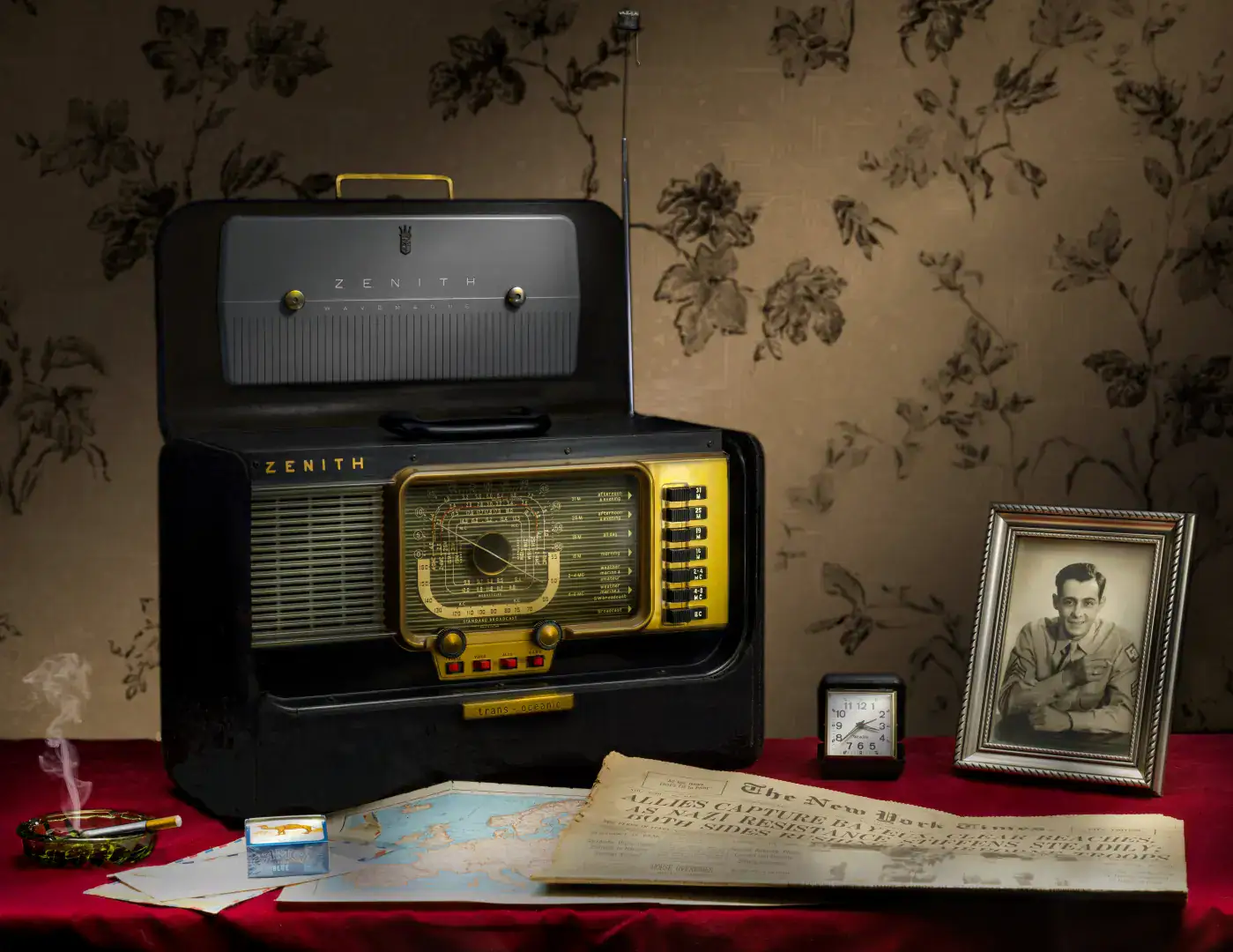
I’ve been thinking about how to describe what I do, and “photographer” has never quite fit.
It’s not that I resist the word. It’s just that the word doesn’t capture where the work actually starts. That place is not at the camera, and not even in the studio. It starts with a pencil and a sketchbook. It starts in conversations with painters. And it starts at the Pittsboro Gallery of Arts, where I serve as treasurer and chair the lighting committee. There, I’m surrounded by artists whose primary medium is pigment on canvas rather than ink on cotton rag. I constantly draw on their instincts about composition, color, and the behavior of light.
I am drawn to art broadly. Photography is the form that art has taken in my hands, but the impulse is broader than the medium.
That distinction shapes everything I make. When I light a still life in a darkened studio, I’m not thinking in photographic terms — about exposure, aperture, dynamic range. I’m thinking in painterly terms. Where should the light come from? How should it fall? How much of the scene should remain in shadow, and what is the shadow holding? The camera is the tool I use to capture those decisions. It is not the author of them.
This post is an attempt to describe what the work is actually about, from the inside. It covers the tradition the work connects to, the practice behind it, and the question it keeps trying to answer.
The Drawing Usually Comes First
Most of the time, before I build a set or select a single prop, I make a sketch. The camera isn’t anywhere near the process yet.
For the pieces that start this way, the sketch is not a minor step. It’s the first act of the work itself. In that moment, the image moves from vague intention to committed form.
The sketch doesn’t have to be elaborate. Often it’s a few lines. The rough mass of the main subject, the edge of a shadow, a note about where the viewer’s eye should enter and rest. But the act of drawing forces a kind of clarity that working in three dimensions doesn’t. When you draw, you can’t defer the hard decisions. You have to choose. The choice you make on paper records what you actually believe about the composition. And it happens before any investment of time or light.
This practice comes directly from painting. Painters work in studies — they establish the composition on paper or in a small oil sketch before they commit to canvas. My colleagues at the Pittsboro Gallery of Arts do this as a matter of course. They know that the problems you don’t solve in the drawing will still be there when the paint goes down. They’ll just be harder to fix.
For still life light painting, the discipline matters especially because the exposure process is essentially irreversible. Once the room goes dark and the shutter opens, I’m executing the plan I’ve already made. When there’s a drawing behind the piece, it’s that plan made concrete. If the drawing was wrong, the photograph will be wrong too, and the only remedy is to start over.
The Sketch Slows You Down
When I do sketch first, I value one thing about it as much as the clarity: it slows me down. The urge to pick up the camera and start shooting is always there. For the careful, deliberate pieces, working the idea out on paper first keeps me from committing to a set before I actually know what I want from it.
Sometimes the Object Leads
The sketch usually comes first, but not always. Some pieces begin instead with a single object that won’t leave me alone, and the composition gets built around it rather than planned ahead of it. Tomatoes, Olive Oil and Garlic started that way — I had fresh tomatoes from the grocery store, and the rest of the scene grew outward from them. Porcelain Coffee Pot, Pears in Blue Bowl worked the same way: the coffee pot came first, then a blue bowl to bring color into the scene, then pears to sit against the blue and complete it. That piece, in the end, is really about texture and color as much as it’s about any single object in it.
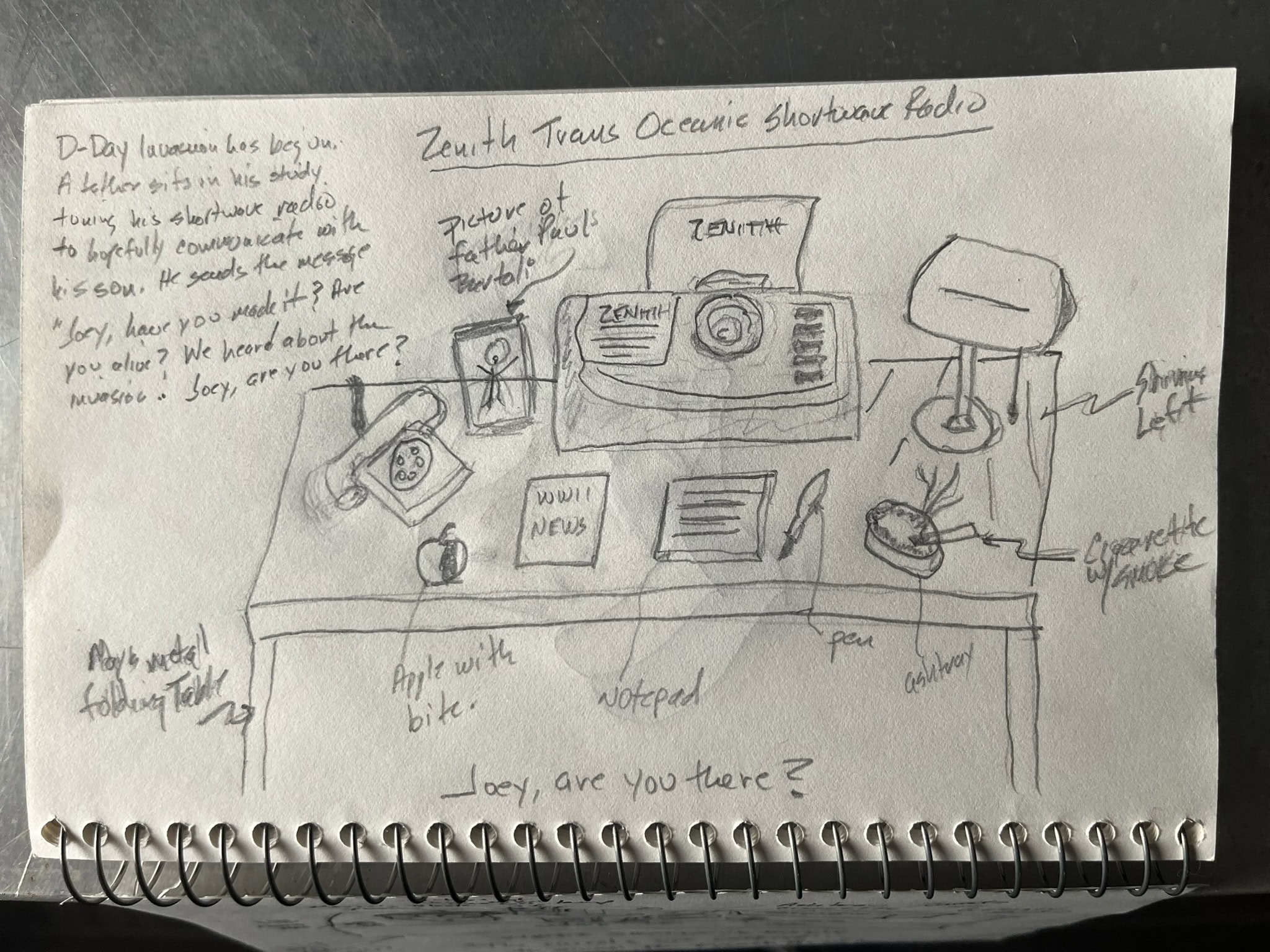
When a piece starts this way, the sketch doesn’t disappear. It just moves. Instead of drawing before I gather anything, I’m sketching and re-sketching as objects get added, checking the arrangement against paper before I commit to lighting it. Sometimes that process sends me looking for something new entirely. Waiting for Word Across the Ocean came together this way — the object that started it was there, the Zenith Trans Oceanic shortwave radio, but it was the sketching afterward, working out what the composition actually needed, that told me it was missing something with real weight and history. That’s what sent me looking for a genuine World War II-era New York Times paper, the kind that would have carried news of D-Day, to anchor the piece. The object came first. The sketch is what told me what else the piece needed.
And Sometimes There’s No Sketch At All
Some of my best work skipped the sketch almost entirely. Forsythia in Bud Vase and Wildflowers on Rustic Wood both came together quickly, more as moments of inspiration than planned compositions.
While driving on Highway 15-501, I saw a beautiful forsythia bush in full bloom on the other side of the road. I immediately made a U-turn, parked near the bush, and cut a branch from the bush. When I got home, I saw that the color and texture of the bud vase worked perfectly with the forsythia branch — the idea was already complete in front of me.
Wildflowers on Rustic Wood was a similar experience. I had the rustic wood for months, lent to me by a friend, not knowing what to do with it from a composition standpoint. While on a walk with my wife, I saw a wildflower bush of reds, purples, and green — the composition came to me.
Sketching is part of the process. But not always.
The Painters Who Shaped How I See
Harold Ross is the photographer who developed and systematized the technique of still life light painting. His workshops — which I’ve studied closely — are the technical foundation for this kind of work. Ross understood that control over light is the fundamental variable in still life photography. So he designed a method that gives the photographer nearly unlimited control. You work in darkness and illuminate the scene one area at a time with handheld light sources. As a result, you can shape the light with a precision no fixed studio setup can match.
What Ross gave me is the method. The ability to construct light rather than borrow it. For every square inch of a still life, I decide how bright the light should be, from what direction, with what color and quality. That control is what makes it possible to pursue the effects I’m after.
But the eye that decides where to point that control came from painters, not photographers. Edward Hopper taught me that light and shadow alone can carry the full emotional weight of an image — a shaft of window light across an empty room, with no figure doing anything in particular, can say more than incident ever could. William Bailey taught me the discipline of quiet. His still lifes — a handful of jugs and bowls arranged with almost mathematical restraint — showed me that a picture doesn’t need incident to hold attention, only order and patience.
Sarah Lamb’s work showed me what a fully realized surface actually looks like under careful, controlled light, the kind of luminosity I’m always trying to get a camera and a handheld light to produce together. And John Whalley’s small, exhaustively patient still lifes and interiors taught me something about time: that a picture made slowly, object by object, decision by decision, holds a viewer’s attention differently than one made quickly, no matter how technically accomplished the quick version is.
None of them work in photography. That’s the point. What I take from each of them isn’t a photographic technique. It’s a way of deciding what matters in a frame before I ever touch a camera.
What the Painters Taught Me
Beyond these influences, I’ve been fortunate to work alongside painters who are serious about their craft. At the Pittsboro Gallery of Arts, I show work alongside painters, sculptors, and printmakers. I’m regularly in conversation with artists who think about light in ways that photographers often don’t.
Painters have to construct light from nothing. There’s no sensor, no lens, no physical reality to fall back on. Every highlight and shadow in a painting is a choice made from scratch. The painter knows exactly what each contributes to the whole. That discipline treats every lit surface and every area of darkness as deliberate, never as an accident of arrangement. It’s something I’ve tried to bring back into the studio.
It’s part of why I chair the lighting committee at the Gallery. How you illuminate a work in a display context is not a secondary concern. It’s part of the work’s meaning. The same print reads differently lit from above with a warm fixture than from the side with a cooler one. These decisions matter just as much as the ones I make in the darkened studio. Light is always doing something, whether you’re choosing it or not.
We put that thinking into practice recently, when the committee replaced the Gallery’s lighting throughout. The spotlights on the artwork are now CRI 90+ at 3000K — warm enough to do justice to skin tones and saturated color without tipping the room into an orange cast — while the ambient lighting runs a cooler 4000K, giving a visitor’s eye a neutral baseline before it settles on a lit piece. We also ran new track lighting into corners of the Gallery that had never had dedicated lighting at all, where good work had effectively been hanging in the dark.
None of those were technical decisions made for their own sake. Every one of them was an artistic decision, made to present the work in the most truthful and flattering light possible — literally. Members and visitors have noticed. The compliments on how different, and how much better, the Gallery looks have not stopped.
The Painters Behind the Work
When I look to the history of Western painting, three names come up again and again: Caravaggio, Vermeer, and Rembrandt. Each of them was, in a profound sense, a photographer before photography existed. Their primary subject was not the objects or people in the picture. It was the quality of light falling on them.
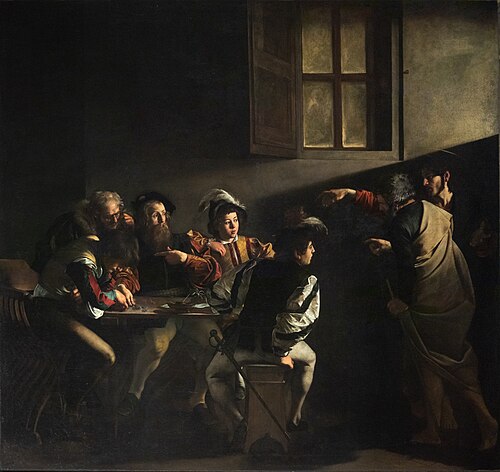
Caravaggio’s chiaroscuro is the dramatic contrast between lit and unlit areas. It was not a stylistic flourish. It was a considered position about what light does when you let it tell the truth about a surface. His light falls onto one surface with total conviction and abandons everything else to darkness. That darkness reads as active rather than absent. It’s not that the unlit areas are missing information; they’re withholding it, and the withholding is deliberate and meaningful.
Vermeer’s Precision and Rembrandt’s Shadow
Vermeer’s light is more domestic and more quiet, but equally precise. Think of daylight falling through a leaded window, or light catching the edge of a sleeve. Vermeer rendered these so carefully that they feel less like painted light and more like trapped light. He studied the same thing I study in the studio: the exact relationship between a surface and the light touching it.
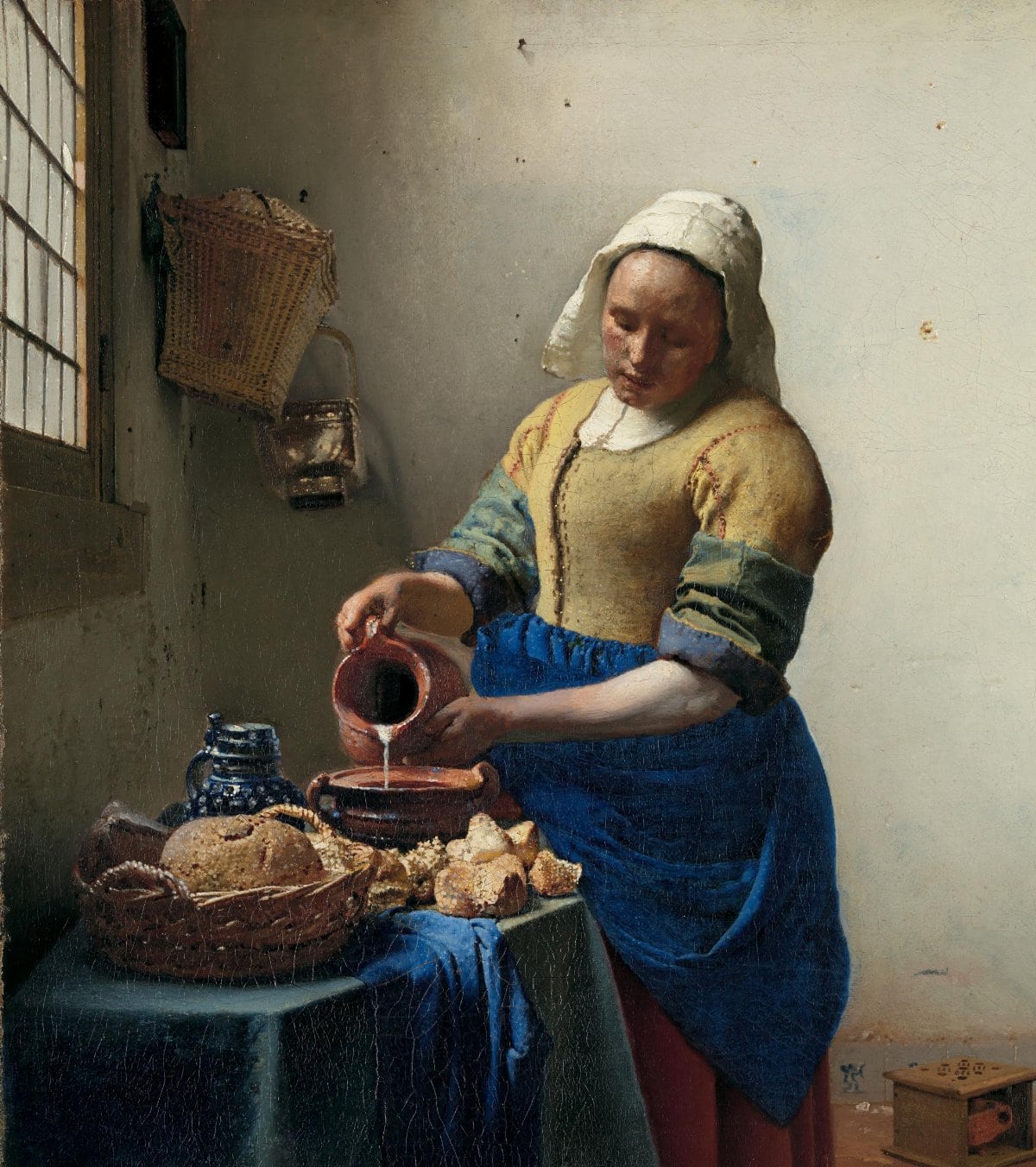
Rembrandt’s contribution to my thinking is his understanding of shadow as space. In Rembrandt’s work, the shadow areas aren’t flat. They contain depth, recession, the suggestion of a world that continues beyond the reach of the light. His shadows are not the absence of light; they’re the presence of something the light has chosen not to reach.
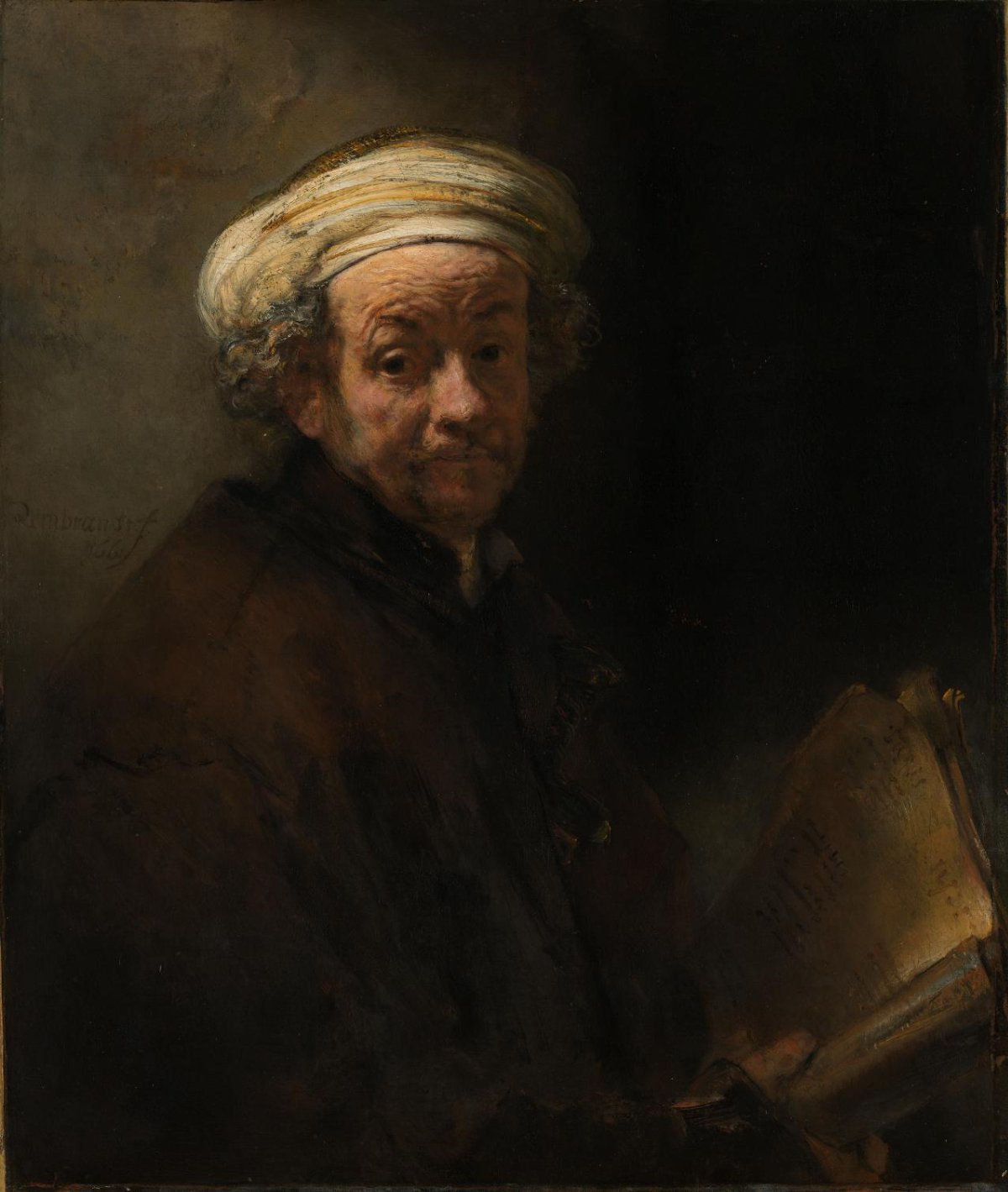
All three of these qualities — Caravaggio’s conviction, Vermeer’s precision, Rembrandt’s spatial shadow — are things I’m working toward in the studio. Not as homage or imitation, but as a set of problems that don’t become obsolete just because the medium changes.
The Tolstoy Quote, Revisited
“All the beauty of life is made up of light and shadow.”
That line sits on my homepage, and it’s there because when I first read it, it felt like a description of something I already believed about the work — not as a photographer, but as someone trying to make art.
The key word, I’ve come to think, is not light or shadow. It’s beauty. Tolstoy doesn’t mean prettiness or comfort. He means the quality of something that stops you. It holds your attention past the first glance and makes you feel the full weight of a particular instant. The Flemish painters understood this. Caravaggio understood it. So did Vermeer. A fall of light across an ordinary surface, against the right depth of shadow, could make the ordinary feel luminous and inevitable.
That’s the tradition I’m working in, with a camera instead of a brush. The connection isn’t incidental or decorative. It’s the reason I work the way I do. The shadows get as much care as what the light reveals.
Shadow as the Other Half
One thing painters understand instinctively, and photographers sometimes learn later, is that shadow is not a failure of light. It’s the other half of the image.
Light reveals. It says: this is here, this is present, this is what I want you to see. Shadow withholds — and in withholding, it implies that the world of the image continues beyond what’s visible. It creates the sense of something just outside the frame, just beyond the reach of the light. A photograph full of light is declarative. A photograph that knows how to use shadow invites the viewer into a kind of participation. You’re shown part of something, and your imagination supplies the rest.
This is why I call this work “the art of light and shadow” rather than just “the art of light.” The two are a single system. Every decision I make about where light falls is also a decision about where it doesn’t fall. Each highlighted surface implies the darkness around it. And every shadow implies the light that created it.
I’m always looking for the same balance in the sketch, the studio, and the final print. It is the threshold between revealing too much and withholding too much. Too much light and there’s nothing left to discover. Too much shadow and there’s no way in. The images that work are the ones that find that threshold and hold it.
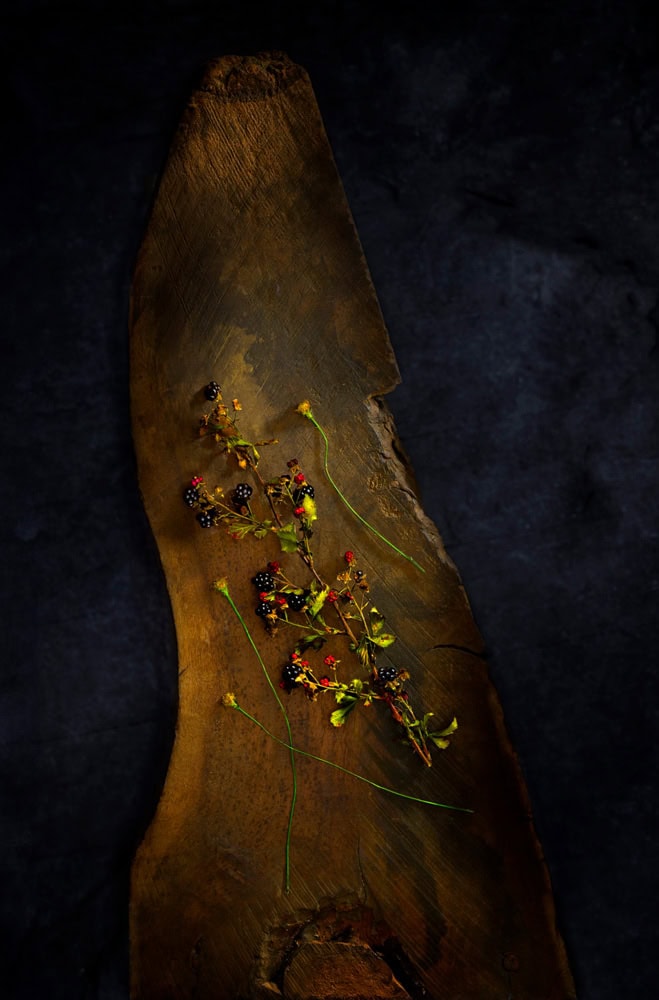
It’s what Tolstoy meant, I think. Not light alone, not shadow alone. The beauty is in the relationship between them — and that’s as true of a life as it is of a photograph.
What I’m Trying to Make
I want to say plainly what kind of experience I’m trying to produce in the viewer, because I think it’s worth being specific.
I’m not trying to produce admiration for technique. Technique is the means; it’s not the end. Suppose someone stops in front of one of my still life light paintings. For a moment, they feel the weight of the pear, the warmth of the radio dial, or the quiet of the egg on its pedestal. That is the work doing what it’s supposed to do. The technique is invisible. The light is what’s there.
I’m also not trying to produce nostalgia, exactly, though the Objects & Memory work and the Narrative pieces draw on historical materials. What I’m after is something closer to presence. The object or the moment is genuinely, specifically here. It is rendered with enough care that the viewer feels its particularity rather than a general impression.
That is the quality I find in the painters I love. Presence, particularity, the feeling of something seen rather than merely shown. It’s what I’m working toward in the studio. Whether I get there on any given piece is a question the piece answers, not me.
I show work at the Pittsboro Gallery of Arts, 44-A Hillsboro Street, Pittsboro, NC. For the full portfolio, the gallery is here. For more on the specific technique behind the still life work, What Is Light Painting Photography? is a good companion.
Archival pigment prints of Forsythia in Bud Vase and Wildflowers on Rustic Wood are available online through Saatchi Art.
Enjoy this kind of work?
I write The Art of Light and Shadow — stories about photography, light, and the creative process behind each image.