
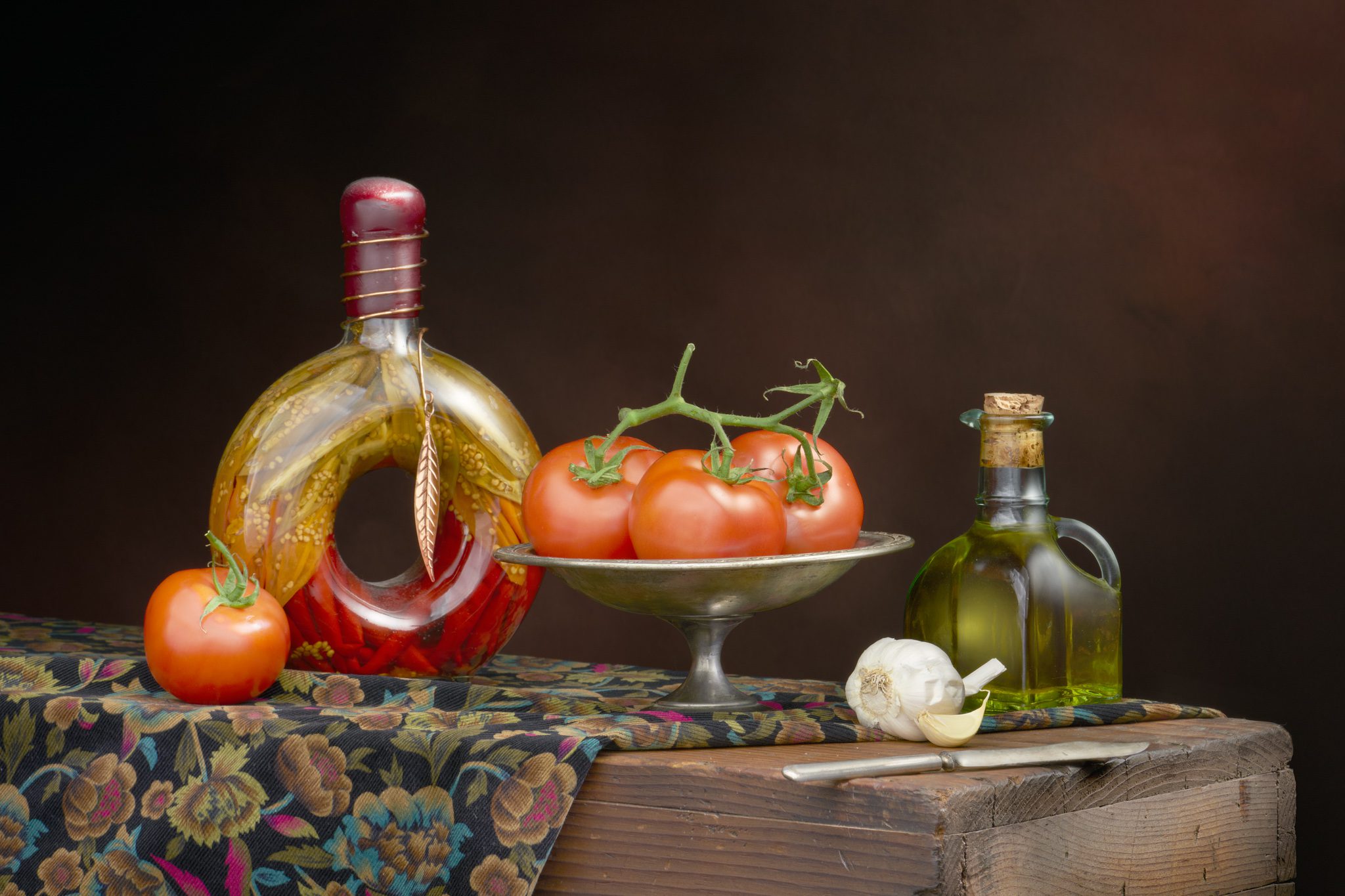
There’s a question I get at nearly every gallery opening about my still life photography. Someone spends a few minutes in front of one of my prints and then turns to ask: Why still life?
Why spend so much care on objects that aren’t going anywhere? Why not capture people, landscapes, or the spontaneous chaos of the world in motion? Isn’t there something limiting about a practice defined by what it excludes — movement, surprise, the decisive moment?
I never mind the question. But my answer tends to surprise people: I don’t think of myself as a photographer first.
I think of myself as an artist who happens to use a camera. Still life, for me, is not a genre I picked because it was convenient. It’s the form of visual art that most naturally fits what I’m actually trying to do.
I Came to Photography Through Painting
Before I ever trip a shutter, I put pencil to paper.
Many of the images I make start with a sketch — the rough placement of objects, the fall of shadow, the geometry of light. That’s how I see. Some pieces begin differently, built outward from a single object instead of planned ahead of time on paper, but the habit of thinking in these terms — placement, shadow, the geometry of light — comes directly from the painters who shaped my sense of what a great image can do: Caravaggio, Vermeer, Rembrandt. Artists who understood that a single candle could illuminate a whole universe of feeling. Artists for whom still was never a limitation — it was the entire point. That instinct has roots stretching back centuries, to the Dutch Golden Age tradition of still-life painting those same artists helped define.
Composition on Paper First
Painters work in studies. They commit to a composition on paper before they touch the canvas. The problems you don’t solve in the drawing will still be there when the paint goes down — only harder to fix. I work the same way and for the same reason. The sketch is the first act of the image. It turns a vague intention into a committed form before I invest any time or light.
This is part of what drew me to still life. The practice demands patience in the same way painting demands it. There’s no event to catch, no window closing. The scene waits for me while I figure out what I actually think about it. That patience isn’t a constraint — it’s the condition that makes the work possible.
Still life photography, at its best, draws on the tradition of painting. The camera is the tool. The eye — shaped by centuries of still life painting, from the Dutch Golden Age through Chardin through Morandi — is what guides it.
The Question of Control
A lot of photography culture romanticizes the decisive moment — that flash of spontaneity where everything lines up and you press the shutter. I respect photographers who work that way. It is genuinely difficult. The results, at their best, carry a quality of aliveness that studio work can’t fully replicate.
But what excites me most is the opposite: the slow, deliberate construction of an image. I think that’s worth defending directly. People sometimes treat control as a lesser ambition in photography — as though the photographer who controls everything is avoiding the real challenge.
The opposite is true in still life. Control is the real challenge.
Nowhere to Hide
In documentary, street, and portrait photography, the world provides a great deal of the image. The photographer’s job is to recognize what’s already happening and position accordingly. That’s hard. But the world contributes something: movement, expression, event, light you didn’t arrange.
In still life, the world contributes nothing. The subject won’t move. It won’t surprise you with an interesting gesture or unexpected expression. The light does exactly what I tell it to do — and if it doesn’t, I adjust. Every element — background, props, camera angle, depth of field, color temperature — comes from a decision I made. The image records those decisions, nothing else.
That’s not easier than documentary work. It’s harder in a specific way: there’s nowhere to hide. When a still life isn’t working, you can’t attribute it to the subject or the moment. Every failure comes from a failure of judgment and seeing.
I can spend an hour moving a single object two inches left and then two inches back, and no one is waiting. That patience isn’t a defect. It’s the whole practice. It lets me honor the painters I admire — artists who spent weeks on a single goblet of wine, chasing the exact way liquid caught a window’s light. I’m doing the same thing with a camera instead of a brush.
Objects Carry Weight
Still life also gives me access to something I find endlessly rich: the lives that objects hold.
A vintage Simpson multimeter isn’t just a piece of equipment. It’s a tool from a specific era, built with specific craft, held by hands that solved problems I recognize from my own years as an electrical engineer. A television’s cathode ray tube, a soldering iron, a Zenith shortwave radio — these things contain time. They contain stories. Photographing them slowly, with controlled light that renders every scratch and patina and worn edge — that feels like an act of remembrance.
This is one dimension of what draws me to still life: the capacity to reveal history embedded in objects. Not to illustrate that history, as a documentary photograph might. Rather, I render it with enough care that the viewer feels it — the weight of use, the evidence of a life lived with these tools, the quality of an era you can read in the design language of its instruments.
A moving subject can’t do this. A person in motion or a landscape in changing light — these exist in the present tense. An object on a table lives in the past and the present at once. The patina on a brass fitting comes from decades ago. The light I paint onto it is from right now. Still life holds both at once.
The Three Directions the Work Takes
Three forces drive my still life work: the love of objects, the tradition of painting, and the patience of controlled construction. Together they push the work in three directions — and understanding them helps explain why the practice feels inexhaustible.
The first is what I call Quiet Poetics: florals, fruit, simple objects asked only to be seen clearly and beautifully. Forsythia in a bud vase. Pears in a blue bowl. An egg on a pedestal. The world stripped to its essentials, lit with care. These pieces ask me the hardest question: whether the light is doing something worth seeing on its own, without any story or symbol to support it.
The second is Objects & Memory: still life built around vintage objects that carry personal or cultural resonance. The electronics tools from my own background. Scientific instruments from mid-century trades. Technology that was once the future and is now evidence of the past. These pieces are personal in ways the others aren’t. The light painting technique renders worn surfaces with a specificity that connects directly to what makes them worth photographing.
The third is Narrative: scenes built around specific historical moments, assembled from period-accurate objects the way a set designer builds a film location. The WWII-era radio scene — a father at a Brooklyn kitchen table, waiting to hear whether his son survived Normandy — begins before I’ve thought about light. I think first about what a scene says. Which objects belong to this specific moment and no other. What the image needs to hold before any exposure is made.
Three very different modes. But they share the same foundation: time to think, time to look, and full control over what ends up in front of the lens.
Light Is Not a Technical Necessity — It’s the Co-Author
I named this blog The Art of Light and Shadow for a reason. In still life photography, light doesn’t just capture the image. It’s the other subject — the thing the objects exist in relation to.
Chiaroscuro: the dramatic interplay of light and dark that Caravaggio developed in the 1590s and that Rembrandt turned into something almost spiritual. That’s the tradition I feel most at home in. A single dominant light source, a dark background, an object emerging from darkness as though the light found it there. When I get that right, the image has gravity — something that makes you feel the weight of what you’re looking at, even if it’s just a coffee pot or a piece of fruit.
Shadow Is the Other Half of Every Decision
Chiaroscuro taught that light is not neutral. Where light falls — and where it doesn’t — makes a statement about what matters and what recedes. Leaving three-quarters of a composition in shadow is as expressive as any choice about what object to place in the light. Shadow isn’t the absence of a choice. It is the choice.
That’s the quality I pursue in every image. Not brightness. Not even beauty in the decorative sense. I’m after the particular gravity that comes from light placed with conviction against darkness that is equally deliberate.
Why Still Life Means Slowing Down
The deepest reason I love still life: it asks me to slow down and pay attention in a world that rarely rewards either.
We are surrounded by objects we’ve stopped seeing. A bowl, a vase, a worn tool, a wilting flower — these things sit at the edge of attention, available to anyone who turns toward them. Still life photography, at its best, is the act of turning toward them and saying: this is worth looking at. This deserves light.
The Discipline of Actually Looking
That act of attention is not passive. It requires the discipline to actually look — not glance — at an object long enough to understand what it is and what it holds. It requires the patience to keep adjusting until the light reveals that understanding rather than just illuminating the surface. It requires the willingness to start over when the image isn’t telling the truth about the object.
These disciplines extend beyond the studio. I carry the habit of looking carefully at ordinary things outside of photography as well. Objects have histories. Surfaces carry evidence. The patina on a piece of brass, the grain in a piece of wood, the wear pattern on a handled tool — these are records, if you look long enough to read them.
Still life photography, practiced with that attention, is a form of bearing witness to the ordinary. The subject isn’t dramatic. The act of doing it justice — making an image that makes the viewer feel the actual weight and presence of the thing — that is.
The Honest Answer
When someone asks me at a gallery opening why I shoot still life, the full answer is everything above. But the short version is this: still life reflects how I actually see and what I actually care about looking at.
Not the event, not the person, not the landscape in changing weather. The object on the table, in controlled light, with time to understand what it holds. That’s where I find the work I most want to make.
I hope, when you stand in front of one of the prints, you feel something of what I found there.
For more on the three genres — Quiet Poetics, Objects & Memory, and Narrative — and what each asks of the work, read The Three Kinds of Still Life I Make. For the technique behind the images, What Is Light Painting Photography? is where to start. The full portfolio is here.
Archival pigment prints of Forsythia in Bud Vase are available online through Saatchi Art.
Enjoy this kind of work?
I write The Art of Light and Shadow — stories about photography, light, and the creative process behind each image.